
Why ZKML 2026 matters for enterprise AI
The trust crisis in artificial intelligence is no longer just about accuracy; it is about provenance and privacy. As enterprises deploy increasingly complex models, the need to verify that an AI ran correctly—without exposing the underlying data or proprietary weights—has become a critical infrastructure requirement. This is where Zero-Knowledge Machine Learning (ZKML) enters the picture, offering a cryptographic guarantee of integrity.
In 2026, ZKML 2026 frameworks have matured from theoretical concepts into practical tools for enterprise software. Traditionally, verifying an AI’s output required either trusting the provider implicitly or re-running the entire model, which is computationally expensive and often impossible if the model is a black box. ZKML solves this by generating a zero-knowledge proof that attests to the correct execution of the model’s logic.
This capability addresses two distinct enterprise pain points simultaneously. First, it protects intellectual property. Companies can verify a competitor’s or vendor’s model output without seeing the training data or the architecture. Second, it ensures regulatory compliance. For industries like healthcare and finance, proving that sensitive data was processed according to strict protocols without being exposed is not just a technical benefit—it is a legal necessity.
The shift toward ZKML 2026 tools represents a move from "trust but verify" to "cryptographically verify." By embedding these proofs directly into the AI workflow, organizations can maintain the speed and utility of machine learning while eliminating the blind spots that have historically hindered adoption in regulated sectors.
Leading ZKML frameworks and platforms
The infrastructure for ZKML 2026 is shifting from academic prototypes to enterprise-grade software. Organizations no longer need to build zero-knowledge proofs from scratch; instead, they rely on specialized frameworks that handle the heavy lifting of converting complex machine learning models into verifiable circuits.
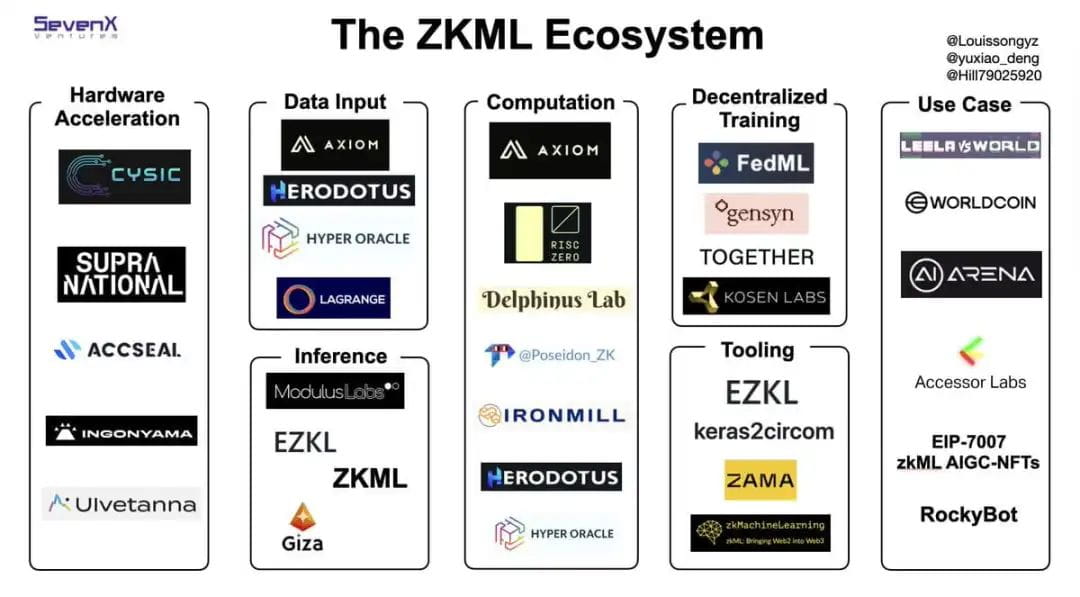
The landscape is divided between commercial platforms offering managed verification and open-source libraries designed for developer flexibility. Polyhedra Network provides a unified SDK that supports a wide range of AI models, allowing enterprises to integrate privacy-preserving verification directly into their existing AI pipelines. For organizations preferring open standards, Worldcoin’s awesome-zkml repository serves as a central hub for curated tools, academic papers, and codebases that drive innovation in the space.
When selecting a ZKML 2026 solution, the decision often hinges on the trade-off between verification speed and model complexity. Commercial platforms typically offer faster proof generation through optimized backends, while open-source frameworks may require more engineering effort to achieve similar performance on large vision models.
| Provider | Type | Model Support | Enterprise Readiness |
|---|---|---|---|
| Polyhedra Network | Commercial | Vision, NLP, Audio | Managed SDK, SLAs |
| Worldcoin awesome-zkml | Open Source | Vision (ResNet, ViT) | Community-driven, Self-hosted |
| ZKML Framework (ACM) | Research/Prototype | Optimized Inference | Experimental, Academic |
Top tools for secure AI inference
Implementing ZKML 2026 architectures requires selecting software frameworks that can handle the computational overhead of zero-knowledge proofs without compromising inference speed. The current landscape favors tools that abstract the complexity of circuit generation, allowing developers to focus on model architecture rather than cryptographic primitives. Below are the most effective solutions for integrating privacy-preserving inference into enterprise workflows.
Polyhedra Network
Polyhedra Network provides a comprehensive infrastructure layer for zkML, enabling developers to verify machine learning computations on-chain. Its primary utility lies in its zkVerify technology, which allows for the creation of zero-knowledge proofs for AI models, ensuring that data privacy is maintained while still providing verifiable integrity. This is particularly valuable for enterprises handling sensitive financial or healthcare data, where regulatory compliance is non-negotiable.
The platform supports a wide range of model types, from simple linear regressions to complex neural networks, making it adaptable to various enterprise needs. By offloading the verification process to a dedicated network, Polyhedra reduces the burden on the primary blockchain, improving scalability. For teams looking to deploy private AI agents, Polyhedra offers the necessary tools to bridge the gap between off-chain computation and on-chain verification.
Circom and SnarkJS
For developers who require granular control over the proof generation process, Circom and SnarkJS remain the standard open-source toolkit. Circom is a domain-specific language designed for writing arithmetic circuits, which form the backbone of zero-knowledge proofs. It allows engineers to define the exact logic of their machine learning models in a way that can be efficiently proven.
SnarkJS complements Circom by providing the JavaScript library needed to generate and verify these proofs in a web environment. This combination is ideal for projects that need to run in-browser or require custom integration with existing JavaScript stacks. While it demands a steeper learning curve compared to higher-level platforms, it offers unparalleled flexibility for custom zkML implementations.
Penumbra
Penumbra is a privacy-focused decentralized finance protocol that has pioneered the use of zero-knowledge proofs for transaction privacy. While primarily known for its privacy-preserving swaps, its underlying technology stack offers valuable insights into integrating ZKML with complex financial workflows. The protocol demonstrates how machine learning models can be used to optimize trading strategies without exposing sensitive user data or proprietary algorithms.
For enterprises interested in financial AI, Penumbra serves as a case study in applying zero-knowledge technology to high-frequency, data-intensive environments. Its approach highlights the potential for combining ZKML with decentralized finance, creating a new paradigm for private, verifiable financial AI.


As an Amazon Associate, we may earn from qualifying purchases.
Implementing ZKML in your workflow
ZKML works best as a clear sequence: define the constraint, compare the realistic options, test the tradeoff, and choose the path with the fewest hidden costs. That order keeps the advice usable instead of decorative. After each step, pause long enough to check whether the recommendation still fits the reader's actual situation. If it depends on perfect timing, unusual access, or a best-case budget, include a simpler fallback.
Frequently asked questions about ZKML 2026
As enterprises move toward verifying AI decisions without exposing sensitive data, zero-knowledge machine learning (ZKML) often raises technical questions about performance, compatibility, and architectural differences. Here are the most common inquiries regarding ZKML 2026 adoption.
No comments yet. Be the first to share your thoughts!