
The black box problem in generative AI
Generative AI models operate as opaque systems. You feed in data, and the model produces an output, but the internal reasoning remains hidden. This "black box" nature creates a significant verification gap. For developers and product managers, the inability to audit how a model arrives at a specific result makes it difficult to trust its decisions, especially when those decisions impact sensitive operations.
Traditional verification methods fall short in two critical areas: intellectual property (IP) protection and user privacy. If you share your model weights to let a third party verify correctness, you expose your core IP. Conversely, if you share your input data to prove the model is working correctly, you violate privacy regulations. This dilemma is particularly acute in regulated industries like healthcare and finance, where patient data and financial records cannot leave secure environments.
ZKML addresses this by allowing a prover to demonstrate that a model executed correctly on specific data without revealing either the data or the model's internal parameters. In healthcare, this means verifying a diagnostic AI’s output without exposing patient records. In finance, it allows banks to confirm a fraud detection model’s accuracy without sharing customer transaction histories. This cryptographic approach transforms AI from a trust-based service into a verifiable one.
How zero-knowledge proofs verify AI inference
Verifying an AI model without exposing the underlying data relies on a specific workflow: translating the model into a mathematical circuit, generating a proof of execution, and validating that proof on-chain or off-chain. This process ensures that the output was produced by the correct model using valid data, without revealing what that data was.
The journey from raw inputs to a verified result follows a structured sequence.
Before any inference can be verified, the AI model must be converted into a format compatible with zero-knowledge protocols. Tools like Ezkl or Mina’s zkML library translate the neural network’s weights and activation functions into arithmetic circuits. This step is analogous to compiling code into machine language; it creates a rigid structure that defines exactly how data must flow through the model.
The private data—such as a patient’s medical records or a user’s financial transactions—is fed into the circuit as a "witness." Crucially, this data remains hidden. The computation happens in a secure environment, ensuring that no one, including the verifier, can see the inputs. This is where the privacy guarantee is established: the system computes the result without ever exposing the sensitive information itself.
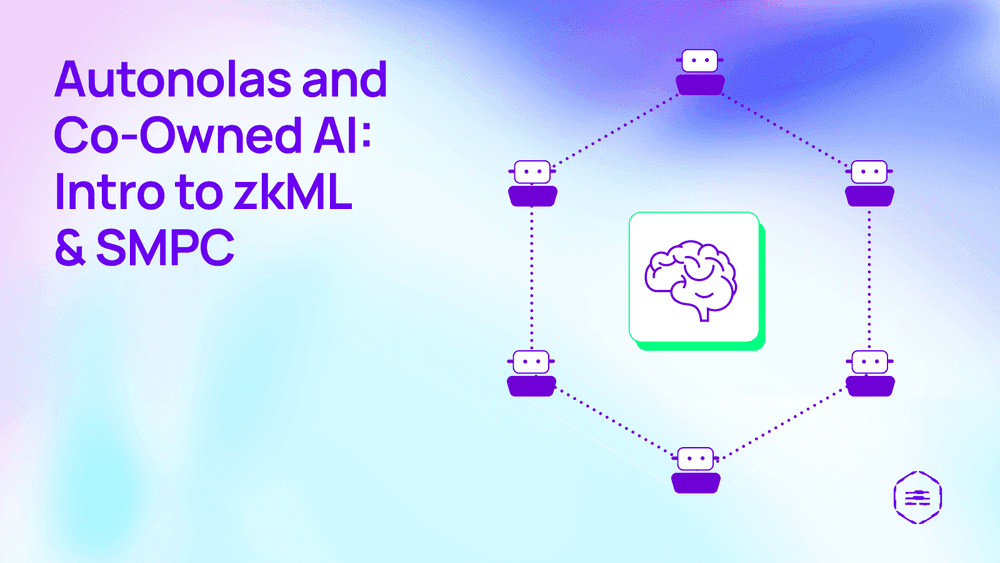
Once the inference is complete, a cryptographic proof is generated. This proof acts as a mathematical certificate that attests to the correctness of the computation. It proves that the output was derived from the model’s logic and the private inputs, without revealing the inputs or the internal state of the calculation. This step is computationally intensive but essential for establishing trust.
The final step involves verifying the proof. This can happen off-chain for speed or on-chain for maximum transparency. On-chain verification ensures that anyone can audit the result’s validity without needing to trust a central authority. The verifier checks the proof against the public model parameters; if the math holds, the output is accepted as authentic and private.
This workflow enables high-stakes applications like healthcare and finance. In healthcare, a hospital can prove that a diagnostic model correctly identified a condition based on private patient data, without sharing that data with third parties. In finance, institutions can verify credit risk scores without exposing individual transaction histories. The proof serves as a universal seal of integrity, decoupling trust in the result from trust in the data source.
Real world ZKML applications in healthcare and finance
ZKML AI moves beyond theoretical cryptography to solve concrete data leakage problems in high-stakes industries. In healthcare, patient records contain sensitive genomic and medical history data that traditional AI models often require to be centralized or exposed to third parties. ZKML allows institutions to verify that an AI model has processed this data correctly without ever revealing the underlying patient information. This enables collaborative research and diagnostic insights while maintaining strict HIPAA compliance and patient privacy.
The financial sector faces similar challenges, particularly in fraud detection and credit scoring. Banks must verify transactions and assess risk without exposing customer spending habits or identity documents to external auditors or model providers. By using ZKML, financial institutions can prove that a credit decision was made using a compliant, auditable algorithm without leaking the applicant’s sensitive financial history. This verification process ensures regulatory adherence while preserving the competitive advantage of proprietary data.
The following table compares how traditional AI verification handles these scenarios against the ZKML approach, highlighting the shift from data exposure to mathematical proof.
This transition from opaque data processing to verifiable privacy allows organizations to harness the power of AI without compromising the trust of their users. As demonstrated by recent implementations, ZKML provides a robust framework for securing sensitive data in both medical and financial applications.
Choosing the right ZKML engine for your stack
Selecting a Zero-Knowledge Machine Learning (ZKML) engine depends on your model’s architecture and your deployment environment. Developers generally choose between general-purpose inference engines like EZKL and blockchain-native libraries like Mina’s zkML. The decision hinges on whether you prioritize execution speed, proof generation overhead, or seamless on-chain verification.
EZKL is designed for deep learning models, supporting frameworks like PyTorch and ONNX. It generates ZK-SNARKs that allow you to prove inference results without revealing the underlying data. This makes it ideal for off-chain applications where computational resources are abundant, such as healthcare diagnostics or financial risk modeling. The engine handles the heavy lifting of converting neural network layers into arithmetic circuits, reducing the barrier to entry for developers familiar with standard ML workflows.
Mina’s zkML library, by contrast, is built for on-chain verification. It enables smart contracts to verify AI inferences directly on the blockchain, leveraging Mina’s succinct blockchain structure. This approach is advantageous for decentralized finance (DeFi) applications where transparency and immutability are paramount. However, it requires models to be adapted to Mina’s specific constraints, which may limit the complexity of the AI architectures you can deploy.
To help you estimate the resource requirements for your specific use case, use the calculator below to project proof generation time and associated gas costs based on model size.
| Engine | Primary Use | Supported Frameworks | Verification Location |
|---|---|---|---|
| EZKL | Off-chain inference | PyTorch, ONNX | Off-chain / L2 |
| Mina zkML | On-chain verification | Custom circuits | On-chain (Mina) |
Common pitfalls in ZKML implementation
Developers often underestimate the computational overhead of proving machine learning tasks. While ZKML promises verifiable inference, the cost of generating proofs for large neural networks can be prohibitive. A simple linear regression might prove quickly, but complex generative models require significant resources to translate weights and activations into circuit constraints. This overhead can delay deployment and increase infrastructure costs, making it essential to evaluate whether the proof's value justifies the compute expense.
Circuit complexity is another major hurdle. Translating non-differentiable operations like ReLU or softmax into arithmetic circuits is not straightforward. Each operation adds constraints, and the number of constraints grows exponentially with model depth. For example, in healthcare, verifying a patient risk score requires mapping medical data into these constraints without exposing the underlying records. If the circuit design is inefficient, the proof generation time can become a bottleneck, rendering the system impractical for real-time applications.
Integration challenges also arise when combining ZKML with existing ML pipelines. Most frameworks are not designed to output the intermediate states needed for zero-knowledge proofs. Engineers must modify training or inference code to expose specific tensor operations, which can break existing workflows. In finance, where model transparency is critical for regulatory compliance, this integration effort can delay audits and compliance checks. Successful implementation requires careful planning to align the ML architecture with the proof system's requirements.
Frequently asked questions about ZKML AI
What is zkML?
Zero-Knowledge Machine Learning (zkML) combines zero-knowledge proofs with machine learning to verify AI computations without revealing the underlying data or model weights. For developers, this means you can prove an inference is correct while keeping the input private. It solves the "black box" problem in AI by providing cryptographic proof of execution.
How much is a zkML coin worth?
The ZKML token is a cryptocurrency project focused on digital privacy and security through blockchain and AI integration. Its market value fluctuates with broader crypto trends. For real-time pricing, check major aggregators like CoinMarketCap. Note that the token's utility is distinct from the technical zkML protocol itself.
Is there AI in ML?
Yes, AI is the broader field of creating intelligent systems, while Machine Learning (ML) is a subset of AI that uses data to train models. zkML specifically targets the ML layer, allowing you to verify the output of these trained models. It ensures the AI made its decision based on the correct logic and data, without exposing the proprietary model.
What is a real world zkML application?
In healthcare, zkML allows hospitals to run diagnostic AI on patient scans without sharing raw medical records, preserving HIPAA compliance. In finance, banks can verify credit scores generated by AI models without exposing individual transaction histories. These examples show how zkML enables privacy-preserving AI deployment in regulated industries.
No comments yet. Be the first to share your thoughts!