
What ZKML actually does
Zero-knowledge machine learning (ZKML) sits at the intersection of cryptographic proof and predictive modeling. It allows a system to prove that a machine learning model ran correctly on specific data without exposing the model’s weights or the input data itself.
In traditional machine learning, trust is binary. You either trust the provider’s black box, or you cannot verify the result. ZKML changes this dynamic by generating a cryptographic proof that the inference was computed correctly according to the model’s logic. This proof is public and verifiable, but it reveals nothing about the underlying computation.
This distinction matters in high-stakes finance, where regulatory compliance and data privacy are non-negotiable. For example, a decentralized lending platform can use ZKML to verify that a borrower’s credit score exceeds a threshold without revealing their financial history or the proprietary scoring model. The proof confirms the result; the data remains private. This capability addresses the core privacy concerns in traditional ML systems while maintaining the integrity of the decision-making process.
Why Enterprises Need Verifiable AI
Enterprises face a paradox in AI adoption: they require absolute transparency to satisfy regulatory audits while demanding strict confidentiality to protect intellectual property. Traditional machine learning models operate as black boxes, making it difficult to prove that a decision was based on legitimate data rather than bias, error, or fraud. This opacity creates significant liability for organizations handling sensitive financial or healthcare information.
Zero-Knowledge Machine Learning (zkML) resolves this tension by decoupling verification from disclosure. It allows an organization to prove that a model executed a specific algorithm correctly on valid inputs without revealing the underlying code, weights, or raw data. This capability is essential for maintaining trust in high-stakes environments where both compliance and proprietary advantage are non-negotiable.
The market driver is clear. Regulatory frameworks increasingly demand explainability and audit trails for automated decisions. zkML provides the cryptographic evidence needed to demonstrate compliance without exposing trade secrets or violating user privacy. As AI integration deepens across finance and healthcare, the ability to verify AI behavior without leaking data becomes a foundational requirement for enterprise security.
How ZKML Proofs Work in Practice
Proving a machine learning model’s output without revealing its internal weights or the input data requires translating complex mathematical operations into a language blockchains understand. This translation process, known as compilation, converts the model’s neural network layers into arithmetic circuits—rigorous logical structures that represent every addition and multiplication the model performs.
Once the model is compiled into these circuits, the system generates a succinct non-interactive argument of knowledge (SNARK) or a scalable transparent argument of knowledge (STARK). These cryptographic proofs are compact enough to be verified instantly on-chain, yet they mathematically guarantee that the output was produced by the exact logic of the original model. This mechanism allows financial institutions to verify credit scores or risk assessments without exposing proprietary algorithms or sensitive client data.
The efficiency of this pipeline is critical for high-frequency financial applications. Recent frameworks, such as the ZKML system detailed in EuroSys 2024, have demonstrated up to 22x smaller proof sizes and 5x faster verification times compared to prior work. This optimization makes it feasible to deploy zero-knowledge proofs for state-of-the-art vision models and large language models in real-world trading environments.
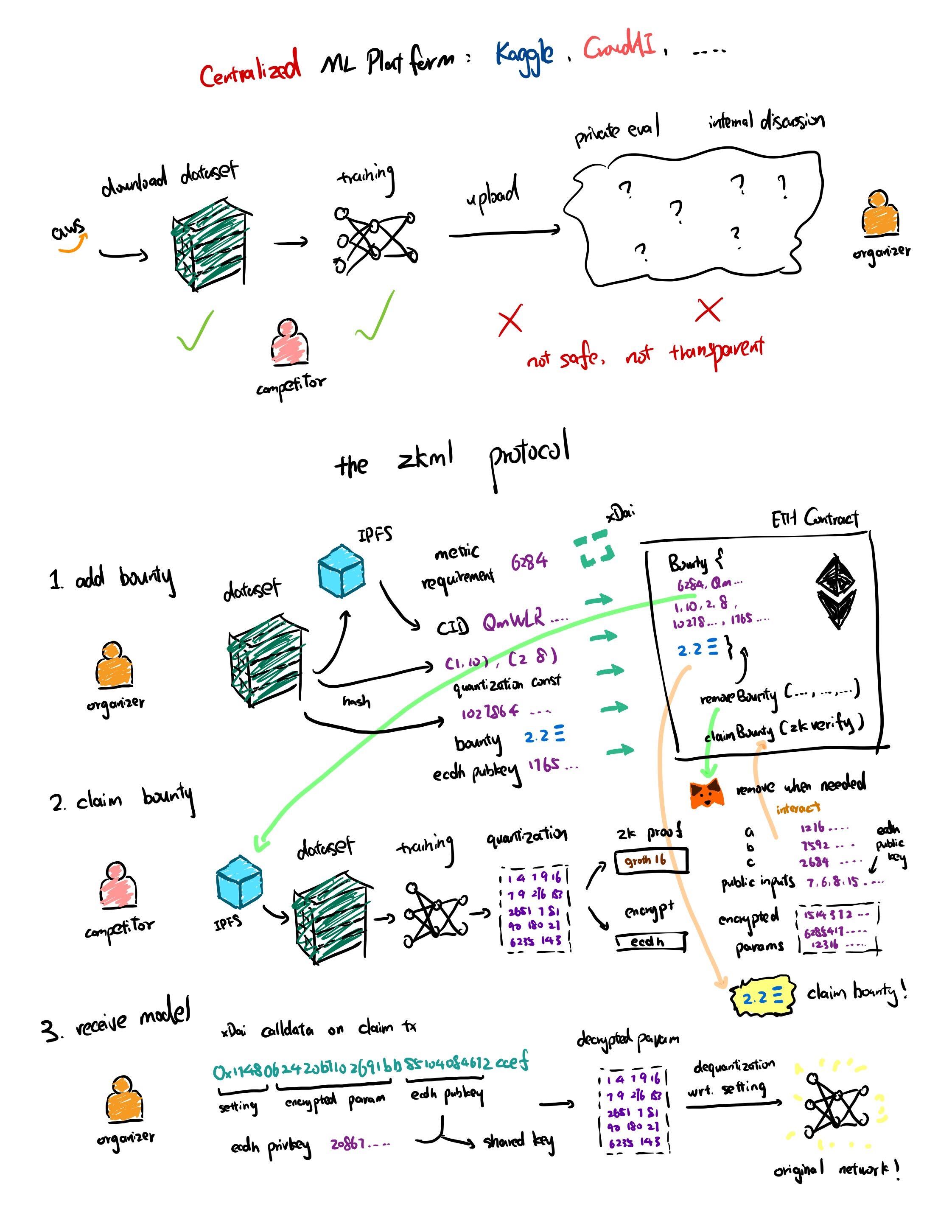
The following chart illustrates the typical lifecycle of a ZKML proof generation pipeline, from model compilation to final on-chain verification.
Implementation Checklist
-
Compile Model: Convert the ML model into an arithmetic circuit compatible with your chosen ZK framework (e.g., Bellperson, Halo2).
-
Select Proof System: Choose between SNARKs (smaller proofs, trusted setup) or STARKs (larger proofs, no trusted setup) based on security requirements.
-
Generate Witness: Compute the private inputs (witness) that satisfy the circuit constraints without exposing them.
-
Produce Proof: Run the prover to generate the cryptographic proof attesting to the correct execution of the circuit.
-
Verify On-Chain: Submit the proof and public inputs to the smart contract for verification, ensuring the output matches the model’s logic.
Where ZKML Meets the Market
ZKML is moving from theoretical cryptography to concrete deployment in high-stakes financial infrastructure. The primary value proposition is the ability to verify AI-driven decisions without exposing sensitive proprietary models or private user data. This capability is critical for decentralized finance (DeFi) and institutional credit systems where transparency and privacy are often at odds.
Private Credit Scoring
Traditional credit scoring models require lenders to access raw financial data, creating significant privacy risks and potential points of failure. ZKML allows a decentralized lending platform to verify that a borrower meets specific credit thresholds without revealing their underlying financial history or the proprietary algorithm used to assess them. The system generates a zero-knowledge proof that confirms the score meets the requirement, preserving the borrower’s financial privacy while enabling the smart contract to execute the loan.
Verifiable Decentralized AI Agents
As AI agents operate autonomously on-chain, verifying their actions becomes a security necessity. ZKML enables these agents to prove they executed a model correctly without exposing the model weights or the input data used for decision-making. This ensures that autonomous agents cannot be manipulated by hidden biases or malicious inputs while maintaining the integrity of the underlying AI logic.
Traditional ML vs. ZKML Inference
The shift to ZKML introduces a trade-off between computational overhead and privacy assurance. While traditional ML inference is transparent and fast, it exposes model weights and data. ZKML inference is computationally heavier but provides cryptographic proof of correct execution without data leakage.
| Feature | Traditional ML | ZKML |
|---|---|---|
| Model Privacy | Low (weights exposed) | High (weights hidden) |
| Data Privacy | Low (raw data required) | High (proof only) |
| Execution Speed | Fast | Slower (proof generation) |
| Verifiability | Centralized audit | Cryptographic proof |
ZKML Market Trends and Costs
The financial ecosystem surrounding ZKML is still in its infancy, characterized by low liquidity and high volatility. As of the latest market data, the native ZKML token trades at approximately $0.008151, with a 24-hour trading volume of just under $850. This limited market depth reflects the niche status of privacy-preserving AI verification compared to broader cryptocurrency sectors.
Generating zero-knowledge proofs for machine learning models remains computationally expensive. The cost of proof generation depends heavily on the complexity of the neural network and the chosen proving system. For small models, costs may be negligible, but scaling to production-grade AI requires significant infrastructure investment. These computational overheads are the primary barrier to widespread adoption, as they directly impact the economic viability of decentralized AI services.
Investors and developers must weigh these operational costs against the value of data privacy. While the technology offers a robust solution for trustless AI verification, the current market pricing and high computational demands suggest that ZKML is still a long-term play rather than an immediate utility for mass-market applications.
No comments yet. Be the first to share your thoughts!