Why black-box AI audits fail
Traditional AI audits operate on a fundamental contradiction: they demand transparency while protecting proprietary intellectual property. In high-stakes environments, such as financial modeling or healthcare diagnostics, organizations cannot expose their core algorithms or sensitive training data to third-party auditors. The result is a "black-box" verification process where stakeholders must rely on sampling, self-reported metrics, or trust in the provider’s internal controls. This approach is expensive, slow, and often insufficient to guarantee model integrity.
Current audit methods typically involve reviewing code snippets or testing outputs against a limited dataset. However, this sampling approach creates a significant trust gap. As Kudelski Security notes, ZKML offers a solution by providing cryptographic proofs that training procedures were executed correctly according to specifications, without revealing the underlying data or model weights. This distinction is critical: traditional audits verify what the model outputs, but they cannot cryptographically prove how the model arrived at that conclusion.
The reliance on sampling also leaves room for subtle manipulation or unintentional drift. A model might perform well on a test set while failing catastrophically in production due to unseen edge cases or biased data subsets. Without a zero-knowledge proof, there is no way to verify that the model deployed is identical to the one validated during training. This opacity undermines regulatory compliance and erodes user trust, particularly in sectors where accountability is non-negotiable.
This structural weakness is why the industry is shifting toward zero-knowledge machine learning (ZKML). By leveraging cryptographic protocols, ZKML allows a prover to demonstrate to a verifier that a specific computation was performed correctly, without disclosing the inputs or the algorithm itself. This shift moves verification from a probabilistic assessment based on samples to a deterministic guarantee based on mathematics, establishing a new standard for trustless AI audits.
How ZKML verification works
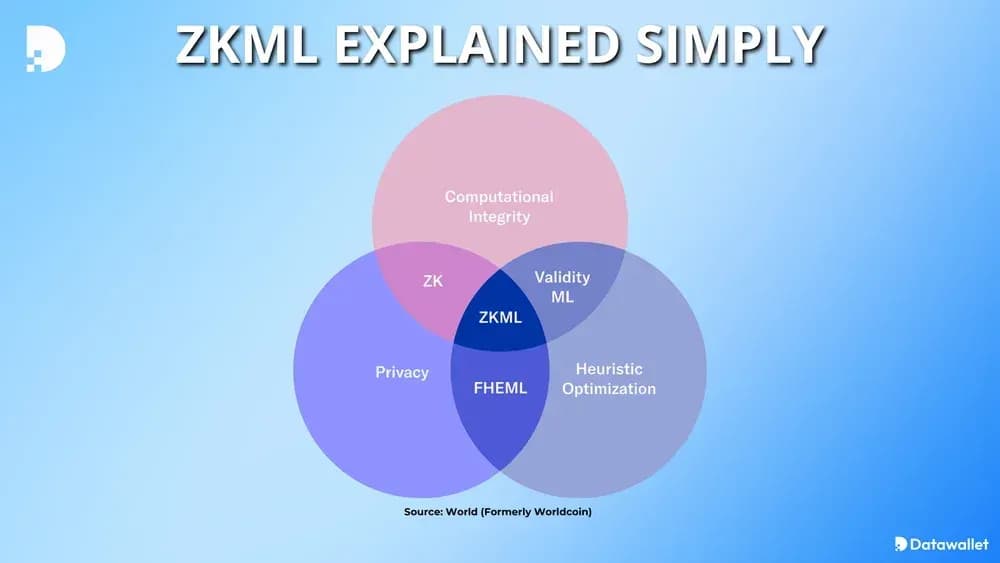
ZKML verification operates by translating machine learning computations into arithmetic circuits, then generating zero-knowledge proofs that validate correctness without exposing inputs or model weights. This mechanism allows a verifier to confirm that a specific model produced a specific output, addressing the "black box" problem inherent in proprietary AI systems.
The process relies on a fundamental asymmetry: computation is expensive, but verification is cheap. An inference provider runs a model on a GPU cluster, generating a proof that the execution was valid. A verifier then checks this proof using minimal computational resources, ensuring integrity without needing to re-run the model or access the underlying data.
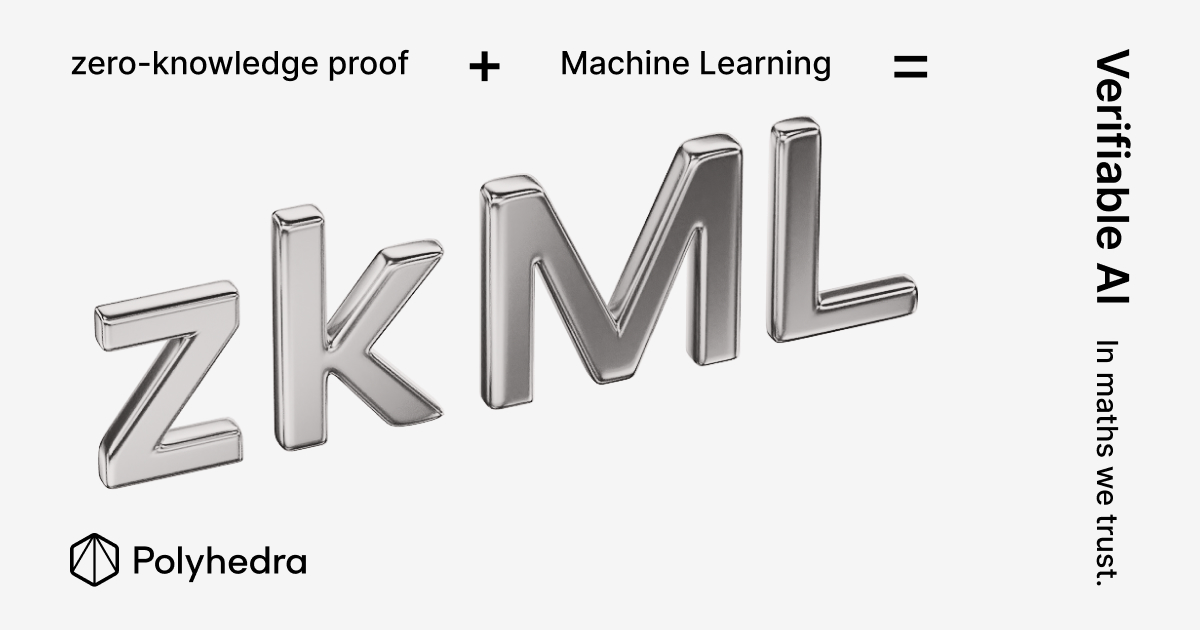
The first step involves converting the machine learning model into an arithmetic circuit. Complex operations like matrix multiplications and non-linear activation functions (e.g., ReLU, sigmoid) are decomposed into basic arithmetic constraints. This compilation process creates a mathematical representation of the model that can be processed by zero-knowledge proving systems. The accuracy of this translation is critical; any deviation from the original model logic will result in an invalid proof.
Once the circuit is defined, the prover runs the model on the input data and generates a cryptographic proof. This proof attests that the computation was performed correctly according to the compiled circuit. Modern systems use optimizations to reduce proving time, allowing for faster generation even on larger models. The proof itself is typically much smaller than the data or model weights it verifies, making it efficient for transmission and storage.
The verifier receives the proof and the public parameters of the circuit. Using a lightweight verification algorithm, the verifier checks the proof’s validity. If the proof is valid, the verifier can be certain that the model was executed correctly on the claimed inputs, without ever seeing the inputs or the model weights. This step is computationally cheap, often taking milliseconds, enabling scalable trust in decentralized AI inference markets.
This architecture ensures that AI providers cannot cheat by using a cheaper, less accurate model, while users retain complete privacy. The proof serves as a cryptographic guarantee of integrity, decoupling trust from the provider’s reputation.
Replacing black-box audits with proofs
Traditional AI audits rely on sampling and trust. Auditors check a subset of data or test a few outputs to infer the model's behavior. This approach is fragile. It assumes the sampled data represents the whole and that the model hasn't been tampered with outside the test set. In high-stakes environments, this "black-box" verification is insufficient. You cannot prove what happened inside the model without seeing it.
ZKML verification changes this dynamic. It allows auditors and users to confirm that a model was trained and executed correctly without needing access to the source code or training data. The system generates a cryptographic proof that the computation followed the specified rules. This proof is deterministic and publicly verifiable. If the proof validates, the output is correct. If it fails, the output is rejected. There is no middle ground for "likely correct."
The shift from sampling to proof is comparable to moving from checking a few pages of a ledger to verifying the entire blockchain. ZKML verification ensures that every step of the machine learning pipeline—from data ingestion to inference—adheres to the agreed-upon protocol. This eliminates the need to trust the model provider. Trust is replaced by mathematical certainty.
The table below compares the fundamental differences between these two verification methods.
| Aspect | Traditional Audit | ZKML Verification |
|---|---|---|
| Trust Model | Trust-based | Cryptographic |
| Scope | Sampled data/outputs | Full computation trace |
| Data Privacy | Requires data access | Zero-knowledge (private) |
| Verifiability | Probabilistic | Deterministic |
| Tamper Evidence | Low | High |
Key hurdles in ZKML adoption
Use this section to make the ZKML Verification decision easier to compare in real life, not just on paper. Start with the reader's actual constraint, then separate must-have requirements from details that are merely nice to have. A practical choice should survive normal use, maintenance, timing, and budget. If a recommendation only works in an ideal situation, call that out plainly and give the reader a fallback path.
The simplest way to use this section is to write down the must-have criteria first, then compare each option against those criteria before weighing nice-to-have features.
No comments yet. Be the first to share your thoughts!