
Why verify AI without exposing data
AI models are becoming the backbone of high-stakes decisions, from credit scoring to medical diagnostics. Yet this reliance creates a fundamental conflict: to get accurate results, organizations must often feed sensitive data into opaque "black box" models. Traditional verification methods force a choice between transparency and privacy. You can either expose the model weights and data to auditors, risking leaks, or trust the provider without proof, risking errors.
Zero-Knowledge Machine Learning (ZKML) resolves this tension. It allows a verifier to confirm that an AI model executed correctly on specific input data without ever seeing the model itself or the underlying data. Think of it like a sealed envelope that proves it contains a valid signature without revealing who signed it or what the document says. This technology combines zero-knowledge proofs with machine learning algorithms to create verifiable AI models that protect privacy while ensuring integrity.
For industries bound by strict regulations like healthcare or finance, ZKML is no longer optional. It enables predictive models to operate on sensitive records without exposing individual patient data or violating compliance standards. By cryptographically proving the correctness of the output, ZKML shifts the trust model from "trust the provider" to "verify the result."

This verification process is critical for maintaining trust in automated systems. As AI models grow more complex, the ability to prove their correctness without compromising security becomes a prerequisite for deployment. ZKML provides the mathematical foundation for this trust, ensuring that AI outputs are reliable without sacrificing the confidentiality of the data that powers them.
How ZKML proves model integrity
Zero-Knowledge Machine Learning (ZKML) transforms an AI model’s inference process into a mathematical puzzle. Instead of trusting the model’s output blindly, ZKML generates a cryptographic receipt—a proof—that the computation was performed correctly on the specified data. This allows anyone to verify the result without needing to re-run the expensive calculation or trust the provider.
The process begins when a user submits input data to the AI model. As the model processes this data to generate an output, a ZKML framework translates the neural network’s operations into a format compatible with zero-knowledge proofs, such as ZK-SNARKs or STARKs. These cryptographic systems allow the system to create a proof that attests to the correctness of the arithmetic operations performed during inference.
This proof acts as a digital signature of integrity. It confirms that the output was derived from the exact model architecture and input data claimed, without revealing the underlying proprietary weights or the private input data itself. The result is a verifiable receipt that can be checked instantly on-chain or off-chain.
The verification step is where the trust model shifts. A verifier receives the input, the output, and the cryptographic proof. Using a public verification key, the verifier checks the proof mathematically. If the proof is valid, the verifier knows with near-certainty that the AI model executed the correct algorithm and produced the right result. This mechanism is critical for high-stakes applications where model tampering or erroneous outputs have significant financial or legal consequences.
Frameworks like the one presented in recent academic research demonstrate that this is no longer theoretical. Systems have been developed to produce ZK-SNARKs for realistic machine learning models, including vision models and large language models like distilled GPT-2. These advancements show that generating proofs for complex AI architectures is becoming computationally feasible, moving ZKML from concept to practical tool.
By embedding verification into the inference pipeline, ZKML ensures that the AI’s decision-making process remains transparent and auditable. This is particularly important in regulated industries like finance and healthcare, where explainability and integrity are mandatory. The cryptographic receipt serves as an immutable record of the model’s behavior, providing a layer of accountability that traditional black-box AI cannot offer.
Steps to implement verifiable inference
Integrating ZKML into your AI pipeline requires shifting from standard model execution to a structured compilation and verification workflow. This process ensures that the AI output is mathematically proven to be correct without revealing the underlying data or proprietary model weights.
Begin by choosing a compiler that supports your specific machine learning framework. Tools like ZKTorch act as universal compilers, allowing you to work with widely used architectures such as large language models (LLMs) and convolutional neural networks (CNNs). The compiler serves as the bridge between your standard AI code and the zero-knowledge circuit.
Translate your trained model into a constraint system. This step converts the mathematical operations of your neural network into a format that can be verified by a zero-knowledge proof. Note that compilation can be computationally expensive, so optimizing your model architecture before this stage is critical to ensure feasible proof generation times.
Execute the inference process using the compiled circuit rather than your original model files. The circuit processes the input data through the defined constraints, ensuring that every step of the calculation adheres to the rules established during compilation. This maintains the integrity of the model while keeping the internal computations hidden.
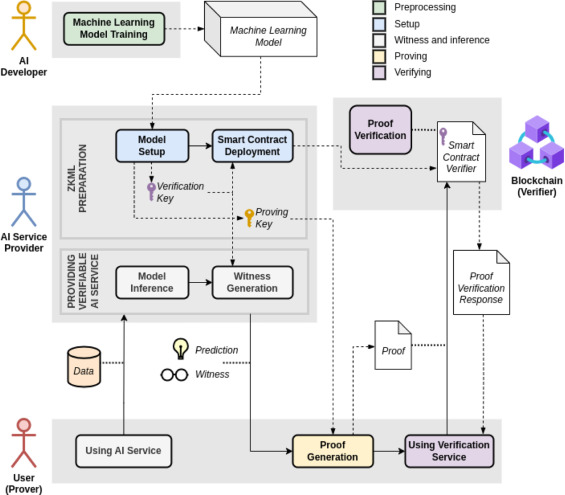
Once inference is complete, the system generates a cryptographic proof. This proof attests that the output was produced by the correct model using the provided input, without exposing the input data or the model parameters. The proof size is typically compact, making it efficient to store and transmit.
Finally, submit the proof to a verifier smart contract or off-chain validator. The verifier checks the proof against the public parameters of the circuit. If the proof is valid, the AI output is accepted as trustworthy. This final step enables privacy-preserving machine learning where sensitive data can be analyzed without ever being exposed.
Real world ZKML applications
Zero-knowledge machine learning (ZKML) moves beyond theoretical cryptography into high-stakes environments where data privacy and model integrity are non-negotiable. In sectors like healthcare and finance, the ability to verify an AI's output without exposing the underlying sensitive data or proprietary algorithms creates a new standard for trust.
Healthcare diagnostics
Patient records are protected by strict regulations like HIPAA, making traditional centralized AI training legally complex. ZKML allows healthcare providers to run predictive models for disease diagnosis or personalized treatment plans without ever exposing individual patient records. The model verifies its own correctness against the encrypted data, ensuring the diagnostic output is accurate while keeping the source data invisible to the algorithm.
Financial fraud detection
Financial institutions face a dual challenge: detecting sophisticated fraud patterns while protecting customer identity and proprietary trading strategies. ZKML enables banks to verify that a fraud detection model executed correctly on private transaction data without revealing the customer's financial history. This ensures regulatory compliance and prevents model inversion attacks, where adversaries might reverse-engineer the model to steal sensitive information.
Common pitfalls in ZKML deployment
Verify AI Outputs with ZKML works best as a clear sequence: define the constraint, compare the realistic options, test the tradeoff, and choose the path with the fewest hidden costs. That order keeps the advice usable instead of decorative. After each step, pause long enough to check whether the recommendation still fits the reader's actual situation. If it depends on perfect timing, unusual access, or a best-case budget, include a simpler fallback.
The simplest way to use this section is to write down the real constraint first, compare each option against it, and choose the path that still works outside ideal conditions.
No comments yet. Be the first to share your thoughts!