What is zero-knowledge machine learning?
Zero-knowledge machine learning (ZKML) is a cryptographic framework that allows anyone to verify that an AI model was executed correctly without revealing the underlying data or the model's proprietary weights. In traditional AI deployments, trust is often placed in the provider; ZKML shifts this dynamic by replacing trust with mathematical proof. It ensures that the output you receive is the genuine result of the specific model and input described, with no tampering or substitution.
Think of ZKML as a sealed, tamper-evident envelope for AI. When a model runs, it generates a zero-knowledge proof (ZKP) attached to its output. This proof acts as a cryptographic receipt. A verifier can check this receipt instantly to confirm the computation was valid, without ever opening the envelope to see the sensitive patient data used for diagnosis or the complex neural network weights that constitute the intellectual property.
This distinction separates ZKML from general privacy-preserving AI techniques like federated learning or homomorphic encryption. While those methods protect data during processing, ZKML specifically guarantees the integrity of the execution. It answers the question: "Did this model actually run on this data, and did it produce this exact result?" This capability is essential for decentralized AI markets, on-chain inference, and any scenario where the verifier cannot audit the model's internal mechanics.
How ZK proofs verify model execution
ZKML transforms machine learning inference into a mathematical puzzle. Instead of running the model in the open, the system converts the model’s operations into an arithmetic circuit. This circuit represents the neural network’s layers, weights, and activations as a series of simple addition and multiplication constraints.
Once the inference is encoded as a circuit, a zk-SNARK or zk-STARK generator creates a cryptographic proof. This proof demonstrates that the output was correctly computed from the input and the model parameters, without revealing the underlying data or the model’s internal weights. The verifier can then check this proof in milliseconds, confirming the result is authentic.
This mechanism is particularly valuable for high-stakes applications. For example, a hospital could use ZKML to verify that a diagnostic AI correctly identified a tumor in an X-ray. The hospital receives a proof that the AI ran the correct algorithm on the specific image, ensuring the diagnosis is valid, while the AI provider’s proprietary model weights remain completely hidden.
Frameworks like zkml and research from ACM have made this process more efficient, allowing even large vision models to generate proofs in practical timeframes. The goal is not just security, but verifiability without compromise.
Protecting IP and user data simultaneously
ZKML solves a fundamental tension in AI deployment: the conflict between model ownership and user privacy. Traditionally, running a model requires exposing either the model weights to the user (risking IP theft) or the user data to the model owner (risking privacy breaches). Zero-knowledge proofs decouple these requirements, allowing both parties to verify computation without revealing the underlying secrets.
Model owners keep their weights secret
For model developers, intellectual property is the primary asset. In a standard inference setup, a client must download the model architecture and weights to run local predictions, or send data to a cloud server where the model lives. ZKML allows the model owner to generate a proof that a specific model was used, without revealing the model itself.
This is particularly valuable for proprietary algorithms in finance or healthcare. A bank can verify that a credit score was generated by its licensed risk model without sharing the model’s parameters with the client or third-party auditors. The proof attests to the integrity of the source code and weights, ensuring the output came from the authorized model, not a modified or stolen version.
Users keep their inputs secret
On the other side, users retain control over their sensitive data. When a user queries a model, ZKML ensures the model owner cannot see the input data used to generate the result. This is achieved by wrapping the input in a zero-knowledge circuit.
Consider a medical AI diagnostic tool. A patient uploads encrypted health data to verify a diagnosis. The model processes the data and generates a proof that the diagnosis is correct based on the input. The model owner sees only the proof and the final result (e.g., "positive" or "negative"), never the raw patient records. This satisfies regulatory requirements like HIPAA or GDPR by design, as the data processor never accesses the plaintext data.
The dual guarantee
This dual privacy model creates a trustless environment. The model owner proves the computation was done correctly using their IP. The user proves they provided valid, unaltered data without revealing it. Both parties gain confidence in the result without sacrificing their respective secrets. This is not just encryption; it is cryptographic verification of the entire process.
Key frameworks driving ZKML adoption
The theoretical promise of zero-knowledge machine learning (ZKML) only becomes practical when developers have tools to build proofs efficiently. Currently, a handful of frameworks are bridging the gap between complex cryptography and usable AI verification. These tools handle the heavy lifting of converting machine learning models into formats that can generate succinct non-interactive arguments of knowledge (SNARKs) without exposing the underlying data or model weights.
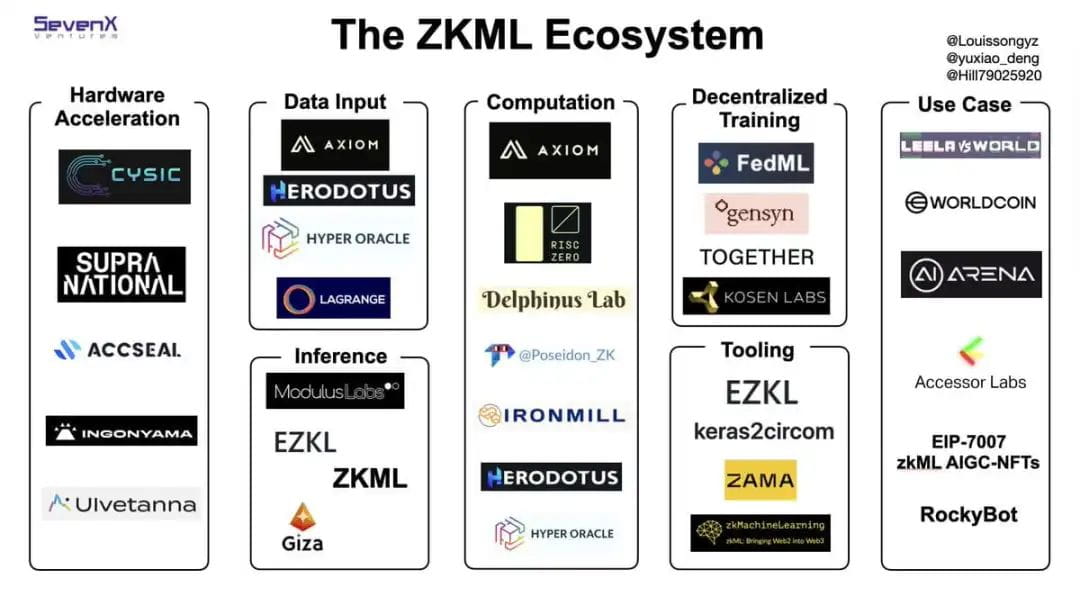
The ecosystem is led by specialized platforms that prioritize different aspects of the verification pipeline, from model compilation to decentralized hosting.
Leading ZKML Frameworks
-
EZKL
A compiler that transforms standard ML models (PyTorch, ONNX) into efficient ZK circuits, focusing on performance for tabular and time-series data. -
Worldcoin ZKML Framework
An open-source toolkit for constructing proofs of ML model execution in ZK-SNARKs, emphasizing developer accessibility and modular proof generation. -
Polyhedra Network
A comprehensive infrastructure layer that offers SDKs and APIs to integrate ZKML verification into existing AI applications with minimal friction.
Choosing the right framework depends on the specific verification needs. EZKL is often preferred for its speed in handling numerical computations, making it suitable for financial or medical data analysis where latency matters. Worldcoin’s approach provides a robust foundation for those building decentralized identity or reputation systems that require proof of AI decision integrity. Polyhedra Network fills the gap for enterprises looking to drop ZKML into existing software stacks via standard APIs.
These tools collectively lower the barrier to entry, allowing developers to verify that an AI model executed correctly without revealing the proprietary logic or sensitive input data involved in the computation.
Common misconceptions about ZKML
The most frequent confusion surrounding ZKML stems from the cryptocurrency token also named ZKML. Seeing the ticker on an exchange often leads people to assume the entire field is just another blockchain project. In reality, ZKML is a cryptographic protocol. The token is merely one speculative application of the underlying technology, not the definition of it.
ZKML stands for Zero-Knowledge Machine Learning. It allows a model owner to prove that a specific AI output was generated correctly without revealing the model weights or the input data. This utility extends far beyond financial speculation. It enables privacy-preserving verification in high-stakes sectors like healthcare, where a patient might need to verify a diagnostic result without exposing their medical history.
Another common misconception is that ZKML is computationally free. Proving machine learning inferences requires significant computational overhead. Generating a zero-knowledge proof for a neural network is far more resource-intensive than standard verification. This cost is the trade-off for the absolute privacy and security the protocol provides. Understanding this balance is essential for evaluating whether ZKML is the right tool for a given application.
No comments yet. Be the first to share your thoughts!