
What zero-knowledge machine learning actually does
Zero-knowledge machine learning (ZKML) is a cryptographic protocol that allows a party to prove that a specific machine learning model produced a specific output from specific inputs, without revealing the model’s architecture, weights, or the input data itself. Unlike standard encryption, which protects data at rest or in transit, or differential privacy, which adds noise to datasets to obscure individual records, ZKML focuses on verifying the integrity of the computation.
In traditional machine learning deployments, verifying that a model ran correctly often requires trusting the provider. You must assume the model is not biased, the inputs were not tampered with, and the output is genuine. ZKML removes this trust assumption. It generates a succinct cryptographic proof that attests to the correct execution of the model’s logic. This proof can be verified by anyone, instantly and with minimal computational overhead, ensuring that the result is mathematically guaranteed to be the output of the claimed model.
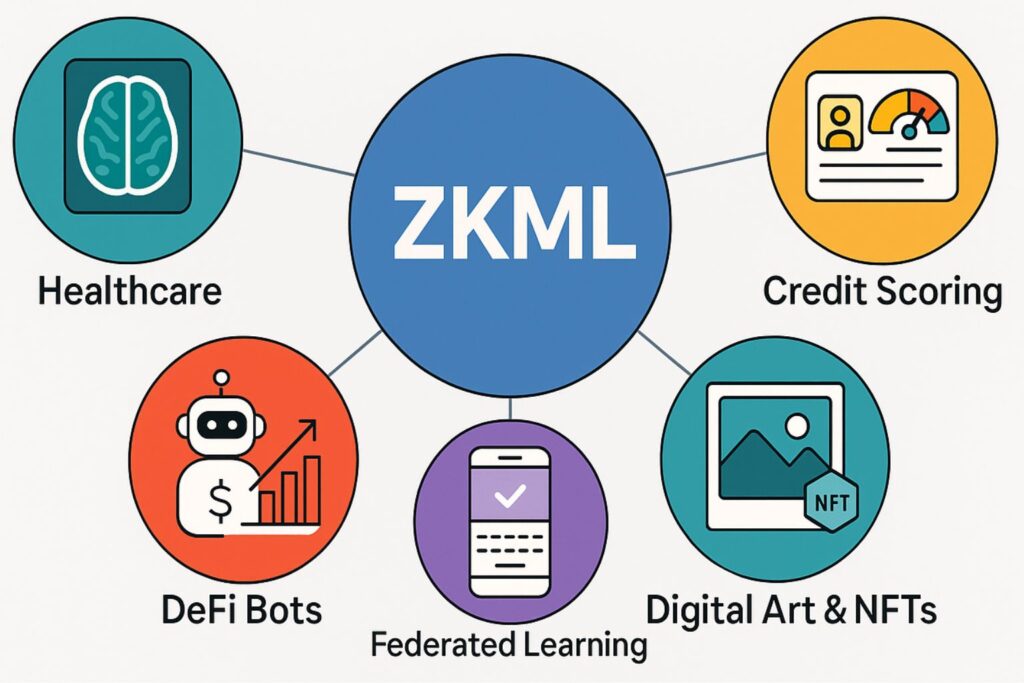
This capability is particularly valuable in high-stakes sectors like healthcare and finance. For example, a decentralized lending platform can use ZKML to evaluate a borrower’s creditworthiness. The system generates a proof that the borrower’s credit score exceeds a required threshold, without exposing their underlying financial data or the proprietary scoring model used. Similarly, in healthcare, a provider could verify that a diagnostic model processed patient data correctly without revealing sensitive patient records or the model’s proprietary algorithms.
Proving model integrity without exposing IP
Use this section to make the ZKML Explained decision easier to compare in real life, not just on paper. Start with the reader's actual constraint, then separate must-have requirements from details that are merely nice to have. A practical choice should survive normal use, maintenance, timing, and budget. If a recommendation only works in an ideal situation, call that out plainly and give the reader a fallback path.
The simplest way to use this section is to write down the must-have criteria first, then compare each option against those criteria before weighing nice-to-have features.
Build a verifiable inference pipeline
Implementing zero-knowledge machine learning (ZKML) requires translating a standard machine learning model into a format that a cryptographic prover can execute. The goal is to create a pipeline where the model’s logic is preserved, but the inputs and internal weights remain hidden. This allows enterprises to verify decisions—such as a credit score or medical diagnosis—without exposing sensitive proprietary data or user privacy.
The process moves from model compilation to proof generation and finally to on-chain or off-chain verification. Each step ensures that the output is mathematically bound to the input, creating a trustless audit trail.
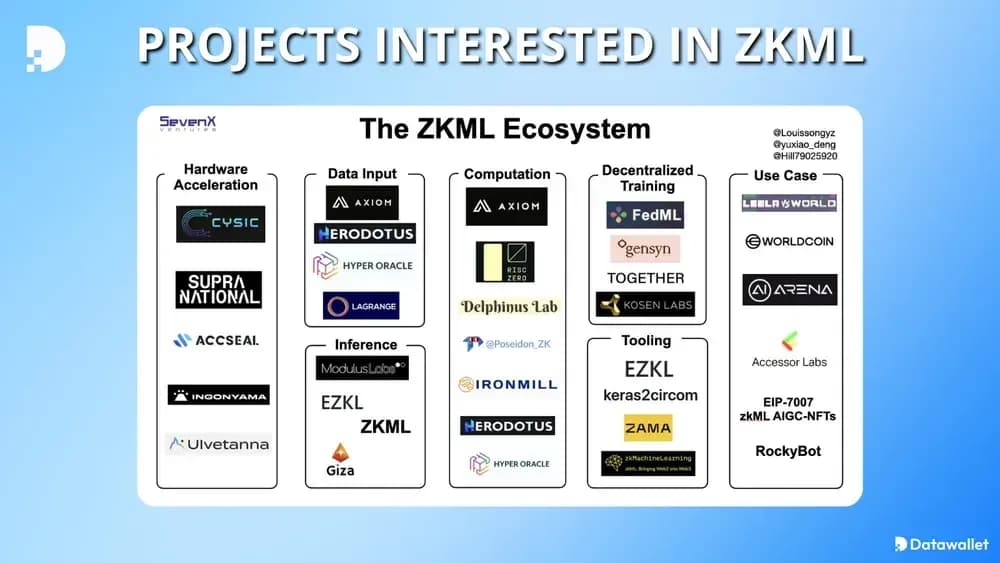
Start by converting your trained model (e.g., PyTorch or TensorFlow) into a rank-1 constraint system (R1CS) or a similar arithmetic circuit. Tools like Circom or Plonky2 are commonly used for this translation. During this phase, you define the mathematical gates that represent the model’s layers. Complex operations like ReLU activations or matrix multiplications must be broken down into basic field operations that the ZK prover can handle efficiently.
With the circuit defined, you need a "witness." This is the intermediate data state generated when the circuit is executed with specific inputs. In a verifiable inference scenario, the witness contains the private inputs (like a patient’s health metrics) and the secret model weights. Crucially, these values are kept in memory and never written to public storage. The witness proves that the computation was performed correctly against the circuit constraints, but it does not reveal the values themselves to the verifier.

The prover engine takes the circuit and the witness to generate a compact cryptographic proof. This proof attests that the witness satisfies all circuit constraints without exposing the witness data. For enterprise use cases, such as verifying a borrower’s creditworthiness, this step might run on a secure server or a decentralized proving network. The output is a small binary proof (often just a few kilobytes) that can be transmitted efficiently over a network.
Finally, submit the proof to a verifier contract or service. The verifier checks the proof against the public circuit parameters. If the verification passes, the system outputs a boolean true, confirming that the AI model produced a valid result based on the hidden inputs. This allows downstream systems to trust the AI’s decision—such as approving a loan or flagging a medical anomaly—without needing to inspect the underlying data or model architecture.
Real-world use cases for verifiable AI
Verifiable AI moves zero-knowledge proofs from theoretical cryptography into production environments where trust is the primary bottleneck. By allowing models to prove their integrity without exposing proprietary weights or sensitive input data, ZKML enables collaboration across competitive or regulated boundaries.
Decentralized Finance Credit Scoring
In decentralized lending, borrowers often need to prove creditworthiness to access capital without exposing their entire financial history to a public ledger. ZKML solves this by generating a proof that the underlying model correctly evaluated the borrower's score against a required threshold. The lender verifies the proof on-chain, confirming the borrower meets the criteria while keeping their transaction history and personal data private.
Private Healthcare Diagnostics
Healthcare providers face strict privacy regulations like HIPAA, which traditionally prevent sharing patient data for collaborative AI training. With verifiable AI, a hospital can run a diagnostic model on patient data and submit a ZK proof that the diagnosis was generated by an approved, unmodified model. This allows medical institutions to validate AI recommendations for critical decisions without ever transmitting sensitive patient records to the verifying party.
Common pitfalls in ZKML implementation
Building a verifiable AI system requires balancing cryptographic rigor with practical performance. The most immediate hurdle is the computational cost of generating proofs for complex models. Large architectures, such as LLMs, impose heavy overhead during the proving phase. Optimization techniques like model distillation are often necessary before circuit compilation to make generation feasible for enterprise workloads.
Circuit complexity also limits scalability. Every non-linear operation in a neural network must be translated into arithmetic constraints, which can explode the circuit size. This complexity directly impacts the trade-off between proof size and verification speed. Smaller, more efficient circuits allow for faster on-chain verification, which is critical for high-throughput applications like real-time fraud detection.
These constraints matter most in sensitive domains. In credit scoring, for example, you must prove a borrower’s score meets a threshold without revealing their financial history. In healthcare, patient privacy must be preserved while verifying diagnostic accuracy. Ignoring these performance and complexity trade-offs can render a ZKML solution too slow or expensive to deploy in production.
ZKML implementation checklist
Before deploying a verifiable AI pipeline, engineers must validate the entire cryptographic stack. This ensures that privacy guarantees hold up under scrutiny and that the system remains efficient for production use. A common application, such as verifying a credit score threshold without exposing financial data, requires rigorous testing at every layer.
-
Model compilation: Ensure the ML model is compiled into a circuit compatible with your chosen proof system (e.g., SNARKs or STARKs).
-
Witness generation: Test witness generation locally to identify bottlenecks before on-chain verification.
-
Proof system selection: Choose between SNARKs (smaller proofs) and STARKs (quantum resistance) based on latency and security requirements.
-
Verifier deployment: Deploy the verifier contract to the target blockchain and test it with real proof inputs.
-
Gas estimation: Estimate gas costs for verification to ensure the solution is economically viable for your use case.
No comments yet. Be the first to share your thoughts!