
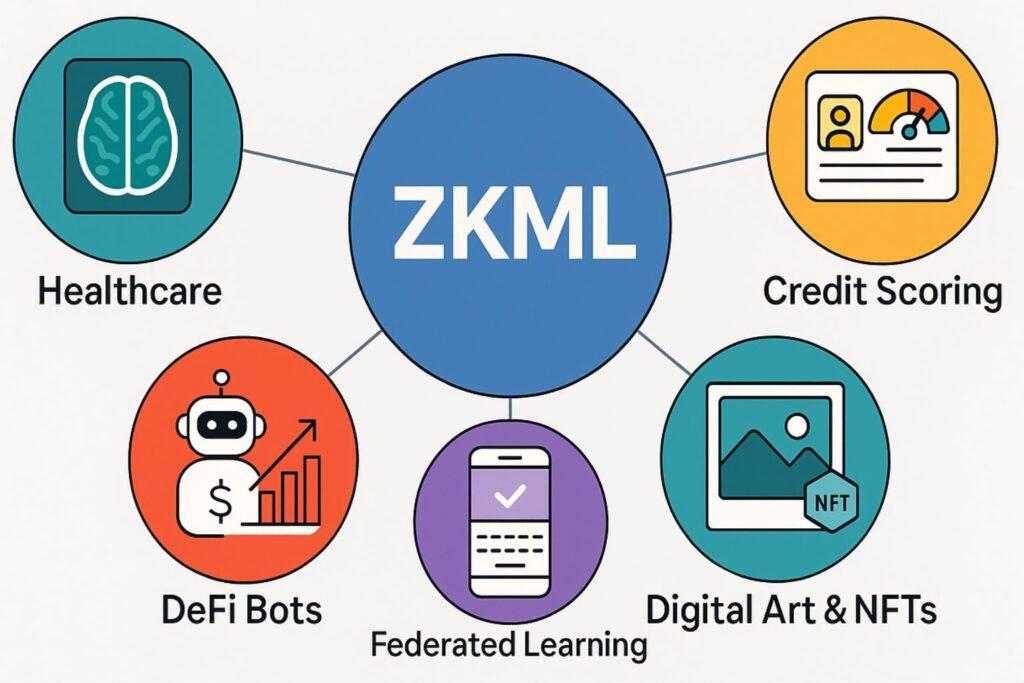
What ZKML Actually Does
Zero-knowledge machine learning (ZKML) is a cryptographic protocol where the party that computes the output on an AI model also generates a proof. This proof allows anyone to verify that the correct model was executed on specific data, without revealing the model's proprietary weights or the user's private input.
Traditional machine learning models are often "black boxes." Even if you trust the provider, you cannot easily verify that the inference was performed accurately or that the model hasn't been tampered with. ZKML solves this by turning the computation into a mathematical statement that can be proven.
The system works in two parts. First, the model runs normally to produce a result. Second, a cryptographic proof is generated alongside that result. This proof attests to the integrity of the computation. Anyone with the public verification key can check the proof instantly.
This distinction separates ZKML from general zero-knowledge proofs. While ZPZs verify any statement, ZKML specifically handles the complexity of neural network operations. It enables privacy-preserving verification on blockchain protocols, ensuring that AI outputs are trustworthy without exposing sensitive underlying data.
The Transparency Problem in AI
Current AI models operate as opaque systems, often referred to as black boxes. Even their creators struggle to trace how specific inputs lead to particular outputs. This lack of internal visibility creates a fundamental trust gap, particularly in high-stakes sectors like finance and healthcare where accountability is non-negotiable.
In traditional software, code is open for audit. In machine learning, the "code" is a massive matrix of weights and biases that defies simple human interpretation. When a model denies a loan or flags a transaction for fraud, the reasoning is buried within layers of non-linear calculations. Stakeholders cannot verify whether the decision was based on valid data or hidden biases without access to the entire model architecture and training history.
This opacity introduces significant risk for institutional adoption. Financial institutions require clear audit trails to comply with regulations and manage liability. Without a way to independently verify that an AI model executed its logic correctly, these organizations remain exposed to operational errors and potential manipulation. The inability to prove model integrity effectively blocks the integration of advanced AI into critical infrastructure.
Zero-knowledge machine learning (zkML) addresses this by allowing verification without disclosure. It enables a system to prove that a model ran correctly on specific data without revealing the model's proprietary weights or the user's private input. This cryptographic assurance transforms AI from a trust-me service into a verifiable utility, bridging the gap between innovation and regulatory compliance.
How ZKML Proofs Work
A practical choice should survive normal use, maintenance, timing, and budget. If a recommendation only works in an ideal situation, call that out plainly and give the reader a fallback path.
The simplest way to use this section is to write down the must-have criteria first, then compare each option against those criteria before weighing nice-to-have features.
Key Projects and Infrastructure
The ZKML landscape is shifting from theoretical cryptography to deployable infrastructure. Three distinct approaches have emerged, each targeting a specific friction point in AI verification: general-purpose proving, edge-device efficiency, and privacy-preserving identity.
Polyhedra Network: General-Purpose Verification
Polyhedra Network positions itself as the foundational layer for zkML, aiming to make any AI model verifiable on-chain. Their approach focuses on creating a universal proving infrastructure that abstracts the complexity of circuit generation. By supporting a wide range of model architectures, Polyhedra allows developers to verify inference results without rebuilding the cryptographic proof system from scratch. This general-purpose strategy lowers the barrier to entry for AI applications that require auditability, such as decentralized oracle networks or automated compliance tools.
EZKL: Edge Inference Efficiency
While Polyhedra targets broad compatibility, EZKL solves the computational bottleneck of running proofs on resource-constrained devices. EZKL enables machine learning models to run directly on edge hardware—such as smartphones or IoT sensors—while generating zero-knowledge proofs of correctness. This is critical for use cases where data privacy is paramount and cloud reliance is unacceptable. By optimizing the proving process for smaller compute environments, EZKL makes ZKML practical for real-time applications like private financial trading bots or secure biometric authentication.
Worldcoin: Privacy and Identity
Worldcoin integrates ZKML into its identity protocol, focusing on proving human uniqueness without exposing personal data. Their ecosystem leverages zero-knowledge proofs to verify that a user is a unique human being without revealing their identity or biometric details. This application highlights the intersection of ZKML and decentralized identity (DID), demonstrating how cryptographic verification can solve the "sybil attack" problem in large-scale digital systems. The approach ensures that verification is both private and scalable, a prerequisite for global digital identity standards.
Infrastructure Comparison
The following table compares the primary focus and target audience of these key infrastructure players.
| Project | Primary Focus | Target Audience | Key Use Case |
|---|---|---|---|
| Polyhedra Network | General-Purpose Proving | AI Developers & DApps | Verifying any AI model on-chain |
| EZKL | Edge Inference | IoT & Mobile Developers | Private inference on constrained devices |
| Worldcoin | Identity & Privacy | Platform Builders | Proof of Human uniqueness |
Market Impact and Token Economics
The financial viability of ZKML infrastructure hinges on the performance of its native token, ZKML. As of the latest market data, the token trades at approximately $0.010337, with a 24-hour trading volume of $2,232.94. This modest liquidity reflects the early-stage nature of the sector, where utility often precedes broad market adoption. The token has recently seen a 5.27% decline, highlighting the volatility inherent in specialized crypto-assets tied to emerging cryptographic standards.
The broader investment thesis centers on the growing need for verifiable AI. As regulatory frameworks tighten around algorithmic transparency, ZKML provides the technical backbone for compliant AI operations. Investors are increasingly viewing ZKML not just as a speculative asset, but as critical infrastructure for the next generation of decentralized machine learning. The integration of zero-knowledge proofs into existing ledgers, such as the XRP Ledger’s recent adoption of Boundless, signals institutional interest in privacy-preserving verification.
No comments yet. Be the first to share your thoughts!