The Problem with Black Box AI
You’ve likely felt the hesitation before trusting an AI’s answer. Whether it’s a medical diagnosis, a legal summary, or a creative draft, the model gives you a result without showing its work. This lack of transparency is the central friction in modern AI adoption. Users need to verify that the output is accurate and unbiased, but providers cannot simply open their source code or share training data. Doing so would expose proprietary algorithms to competitors and violate the privacy of the individuals whose data trained the model.
This creates a standoff. On one side, you have the "black box" nature of generative models, where even the creators sometimes struggle to explain exactly how a specific conclusion was reached. On the other side, there is the rigid requirement for intellectual property protection and data privacy. Traditional verification methods—like publishing code or datasets—fail here because they either leak secrets or compromise user confidentiality.
ZKML AI solves this tension by shifting the focus from what the model knows to how it processed the request. Instead of sharing the model itself, ZKML generates a cryptographic proof that the AI executed its logic correctly on the provided input. This allows you to verify the integrity of the output without ever seeing the underlying weights or the private data that fed the system. It is the difference between trusting a chef’s reputation and actually tasting the meal to confirm it was cooked properly.
How ZKML AI proofs work in practice
We don’t trust AI models because we can’t see inside them. When a generative model processes private data, the input and the output are visible, but the reasoning is a black box. This opacity creates a verification gap: stakeholders need to know the model followed its rules without exposing the underlying data or the proprietary weights.
ZKML AI solves this by turning machine learning inference into a mathematical proof. Instead of running the model on raw data and hoping for the best, we convert the entire inference process into an arithmetic circuit. This circuit acts like a digital ledger of every calculation the model performs.
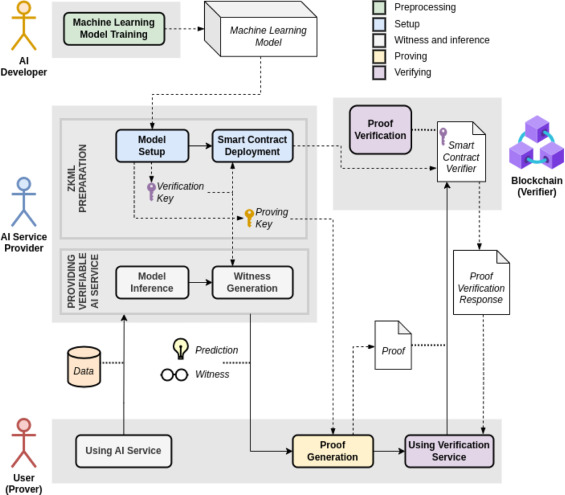
The first step is converting the neural network’s operations—matrix multiplications, activations, and biases—into a set of arithmetic constraints. Each operation becomes a "gate" in a circuit. For example, a simple multiplication $a \times b = c$ becomes a constraint that the system can verify. This process, known as arithmetization, transforms complex AI logic into a format that zero-knowledge proofs can understand.
Once the circuit is defined, we feed it the specific data for the inference. The model’s private weights and the user’s input data become "witnesses"—secret values that satisfy the circuit’s constraints. The system doesn’t reveal these witnesses; it only uses them to prove that the circuit was evaluated correctly. This ensures that the model’s proprietary architecture remains hidden while still allowing for public verification.
Using a cryptographic protocol like ZK-SNARKs (Succinct Non-Interactive Arguments of Knowledge), the system generates a tiny proof. This proof is mathematically bound to the circuit and the witnesses. It attests that "a valid input was processed by this specific model to produce this output" without revealing the input, the output’s internal steps, or the model’s weights. The proof is often just a few hundred bytes, regardless of the model’s complexity.
Finally, a verifier checks the proof. This verification is fast and cheap. If you are running this in a decentralized environment, the proof is submitted to a smart contract, which checks its validity instantly. If it’s off-chain, a client can verify the proof locally. If the proof holds, the inference is accepted as authentic. The verifier gains 100% confidence in the result without ever seeing the private data or the model’s inner workings.
This workflow transforms trust from a leap of faith into a mathematical certainty. By decoupling the result from the process, ZKML AI allows organizations to use powerful generative models while maintaining strict data privacy and intellectual property protection.
Choosing the right ZKML framework
When trust is low and verification is mandatory, the choice of framework dictates your ability to operate. You need a ZKML AI solution that balances proof generation speed with the specific model architectures you rely on. Most teams stall not because the math is too hard, but because the tooling doesn't support their existing stack.
EZKL, Mina, and Polyhedra represent the current leading options, each solving the verification problem with different trade-offs. EZKL focuses heavily on performance for standard deep learning models. Mina offers a lightweight library ideal for on-chain verification. Polyhedra provides a broader infrastructure layer for enterprise-grade zkML pipelines. Comparing these tools side-by-side helps you avoid the common pitfall of selecting a framework that cannot handle your model's complexity.
| Framework | Primary Strength | Model Support | Developer Maturity |
|---|---|---|---|
| EZKL | Speed | CNNs, Transformers | Beta |
| Mina | On-chain | Custom circuits | Production |
| Polyhedra | Infrastructure | Broad ecosystem | Early Access |
EZKL is the go-to for developers prioritizing inference speed. It compiles models into efficient circuits, making it suitable for high-frequency applications where latency matters. However, its support for newer or highly specialized architectures is still evolving. Mina’s zkML library takes a different approach, focusing on minimal proof sizes that fit comfortably on-chain. This makes it attractive for decentralized applications, though it requires more manual circuit design. Polyhedra aims to abstract the complexity entirely, offering a platform that supports a wider variety of models out of the box. It is less about raw speed and more about ease of integration for complex enterprise systems. Your choice depends on whether you value speed, on-chain efficiency, or broad compatibility.
Common pitfalls in ZKML implementation
When ZKML AI proofs fail, it is rarely because the cryptography is broken. It is usually because the machine learning model behaves differently inside a proof system than it does in standard training environments. This divergence creates a trust gap: users cannot verify the output, and developers cannot deploy the model.
The most frequent symptom is non-determinism. Standard neural networks rely on floating-point arithmetic, which is inherently non-deterministic across different hardware architectures. A proof generated on one GPU may not verify on another. To fix this, developers must replace standard layers with deterministic equivalents, such as fixed-point arithmetic or quantized integer operations, ensuring the proof remains consistent regardless of the execution environment.
Precision loss is the second major hurdle. Zero-knowledge circuits operate on finite fields, not continuous real numbers. If a model’s weights or activations are not properly bounded or quantized, the arithmetic overflow will cause the proof to fail or produce incorrect results. This requires rigorous testing of precision bounds before deployment.
Use this checklist to validate your ZKML AI pipeline before going live:
-
Verify all operations are deterministic across target hardware
-
Check precision bounds for all weight and activation tensors
-
Validate proof size and verification time against budget
-
Test edge cases with zero or negative inputs
Addressing these issues early prevents the most common failure modes in zero-knowledge machine learning. By prioritizing deterministic operations and precise arithmetic, you ensure that the AI model remains both verifiable and trustworthy.
Real world use cases for verifiable AI
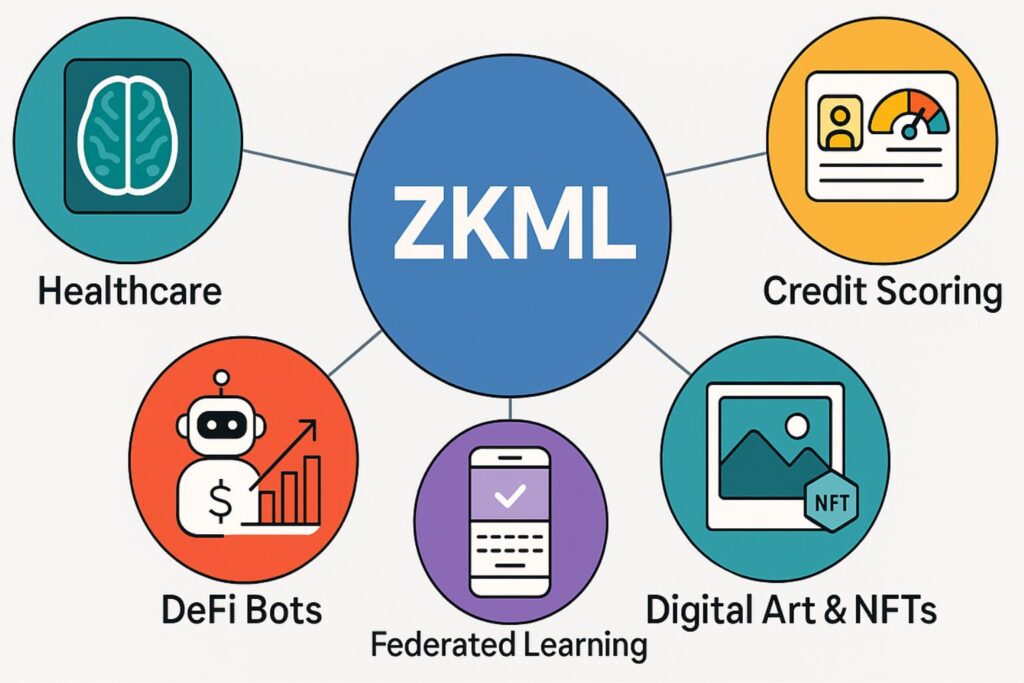
The lack of trust in AI outcomes is a tangible barrier to adoption. When models operate as black boxes, stakeholders cannot verify if decisions are fair, accurate, or compliant. ZKML AI addresses this by allowing verification of AI processes and outcomes without exposing proprietary models or personal data. This capability is shifting from theoretical research to concrete deployment in high-stakes environments.
Financial compliance and audit trails
Banks and fintech firms face strict regulatory requirements to explain credit decisions and detect fraud. Traditional AI models often obscure their reasoning, creating audit gaps. ZKML AI enables institutions to prove that a credit scoring model followed specific regulatory rules without revealing the underlying proprietary algorithm or sensitive customer data. This creates a verifiable audit trail that satisfies regulators while protecting intellectual property.
Healthcare data privacy
Medical research requires access to vast amounts of patient data, but privacy laws like HIPAA restrict sharing. ZKML AI allows researchers to verify that a diagnostic model was trained on legitimate, anonymized datasets without exposing individual patient records. This ensures that the AI’s predictions are based on valid data sources, maintaining patient privacy while enabling collaborative medical advancements.
Supply chain integrity
Companies need to verify that products meet ethical and quality standards throughout complex supply chains. ZKML AI can verify that a manufacturing model correctly identified defective items or that a sourcing algorithm selected compliant suppliers. This verification happens on-chain, providing an immutable record of compliance without revealing sensitive business logic or supplier contracts.
Frequently asked questions about ZKML
Can ZKML verify any AI model?
ZKML AI is not a universal patch for every generative model. It works best with specific architectures like linear regression or simple neural networks that can be efficiently translated into arithmetic circuits. Complex models, such as large language models (LLMs) with billions of parameters, currently face significant computational hurdles. As noted by Polyhedra Network, the technology is evolving to handle more complex logic, but today it is most practical for models where the inference path is relatively straightforward.
Is ZKML too slow for real-time applications?
The computational overhead of generating zero-knowledge proofs is currently the biggest bottleneck for real-time use. Proving an AI inference can take minutes or even hours, depending on the model size. This makes it unsuitable for latency-sensitive tasks like live video analysis or instant chat responses. However, for batch processing, compliance audits, or verifying model integrity after deployment, the delay is often acceptable. Researchers are actively working on optimizations to reduce this proof generation time.
How does ZKML protect intellectual property?
ZKML AI allows you to verify that a model ran correctly without revealing the model weights or the private data used for inference. This is critical for proprietary AI. A company can prove their model made a correct prediction based on a user's private data without ever seeing the data or exposing their trade-secret algorithm. This creates a trust layer where the model owner protects their IP and the user protects their privacy simultaneously.
No comments yet. Be the first to share your thoughts!