What is zero-knowledge machine learning?
Zero-knowledge machine learning (ZKML) is a cryptographic protocol that allows a model to prove it executed a specific computation without revealing the underlying weights, the input data, or the final output. In this system, the party generating the result is called the prover, and the party checking the validity is the verifier. The prover creates a cryptographic proof that demonstrates the model ran correctly on the provided data, while the verifier checks that proof without ever seeing the raw information.
This approach solves a fundamental trust problem in AI. When you send private data to a cloud-based model, you must trust that the provider isn’t stealing your data or manipulating the result. ZKML removes that requirement. It is similar to a security checkpoint: you prove you have a boarding pass without handing over your passport or revealing your identity to the scanner.
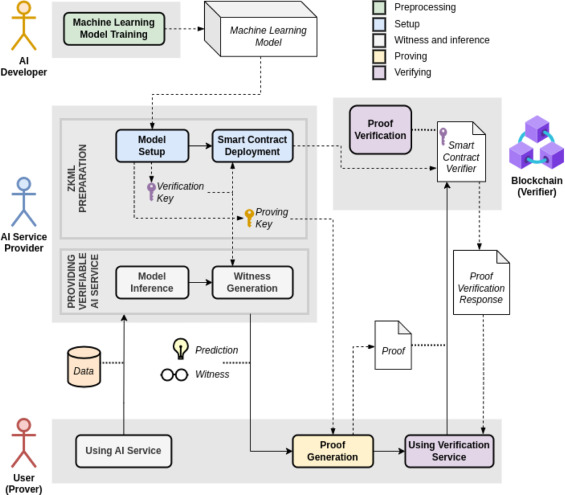
The primary use case for ZKML is verifiable inference. A user can submit an encrypted query to a model and receive a proof that the output was generated by the exact model architecture promised, without the model owner ever seeing the query. This is critical for financial auditing, healthcare diagnostics, and any scenario where data privacy and model integrity are non-negotiable. While the technology is still maturing and faces significant computational overhead, it provides a mathematically rigorous foundation for trust in AI systems.
Why traditional ML verification fails
The core problem with current machine learning systems is a lack of transparency. When a user submits data to a cloud-based AI model, they are essentially handing over a black box. The provider runs the inference, but the user has no way to verify that the model executed the correct algorithm, used the intended weights, or processed the data without bias.
This "trust gap" forces users to rely entirely on the provider’s honesty. In high-stakes environments like healthcare diagnostics or financial fraud detection, this is unacceptable. Users need proof that the computation happened exactly as promised, without having to trust the provider’s internal logs or source code.
Traditional auditing methods are too slow and invasive. To verify a model, an auditor would typically need access to the proprietary weights and the original training data. This exposes the provider’s intellectual property and the sensitive personal information of the users who trained the model. It is a lose-lose situation: either the provider loses their competitive edge, or the user loses their privacy.
Zero-Knowledge Machine Learning (ZKML) solves this by separating the computation from the verification. It allows a model to generate a cryptographic proof that it ran correctly on specific data. This proof is short and easy to verify, without revealing the model’s architecture, the weights, or the input data itself.
How ZKML Ensures Model Authenticity
Verifying that an AI model hasn’t been tampered with requires more than checking a digital signature. Zero-knowledge machine learning (ZKML) translates the model’s logic into a mathematical proof that confirms the output is correct without revealing the underlying data or weights. This process transforms opaque neural networks into auditable, verifiable systems.
The workflow follows a strict sequence: compilation, circuit generation, proof creation, and verification. Each step ensures that the model behaves exactly as intended, providing a cryptographic guarantee of authenticity.
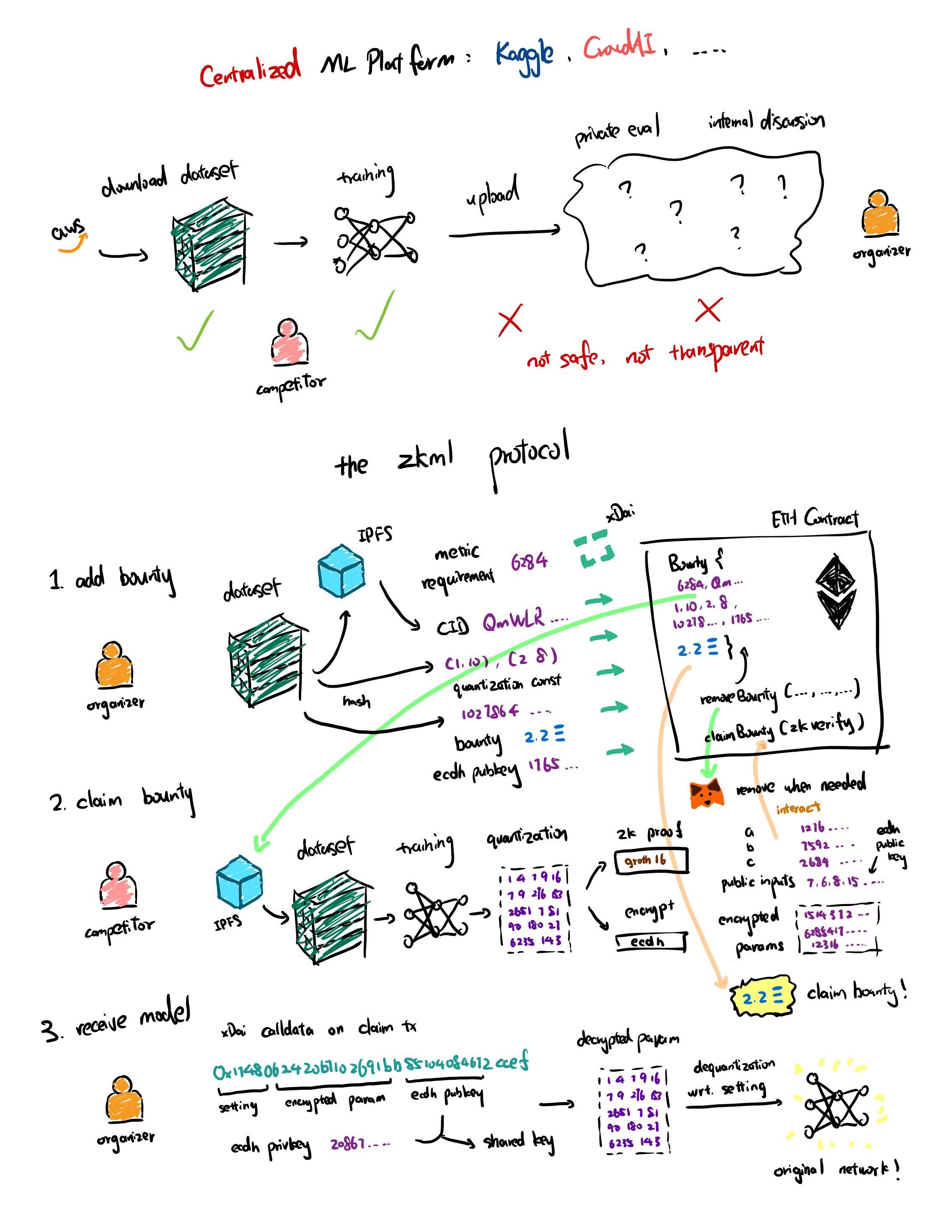
The first step is converting the trained machine learning model into a format suitable for zero-knowledge proofs. Standard frameworks like TensorFlow or PyTorch are not directly compatible with ZK circuits. The model is compiled into a simplified arithmetic representation, stripping away non-essential operations while preserving the core inference logic. This ensures the mathematical structure can be mapped to constraints.
Next, the compiled model is translated into arithmetic circuits. These circuits consist of gates (addition and multiplication) that represent the model’s operations. Each gate corresponds to a constraint in the proof system. Complex layers, such as convolutions or attention mechanisms, are broken down into these basic arithmetic components, creating a blueprint for the proof.
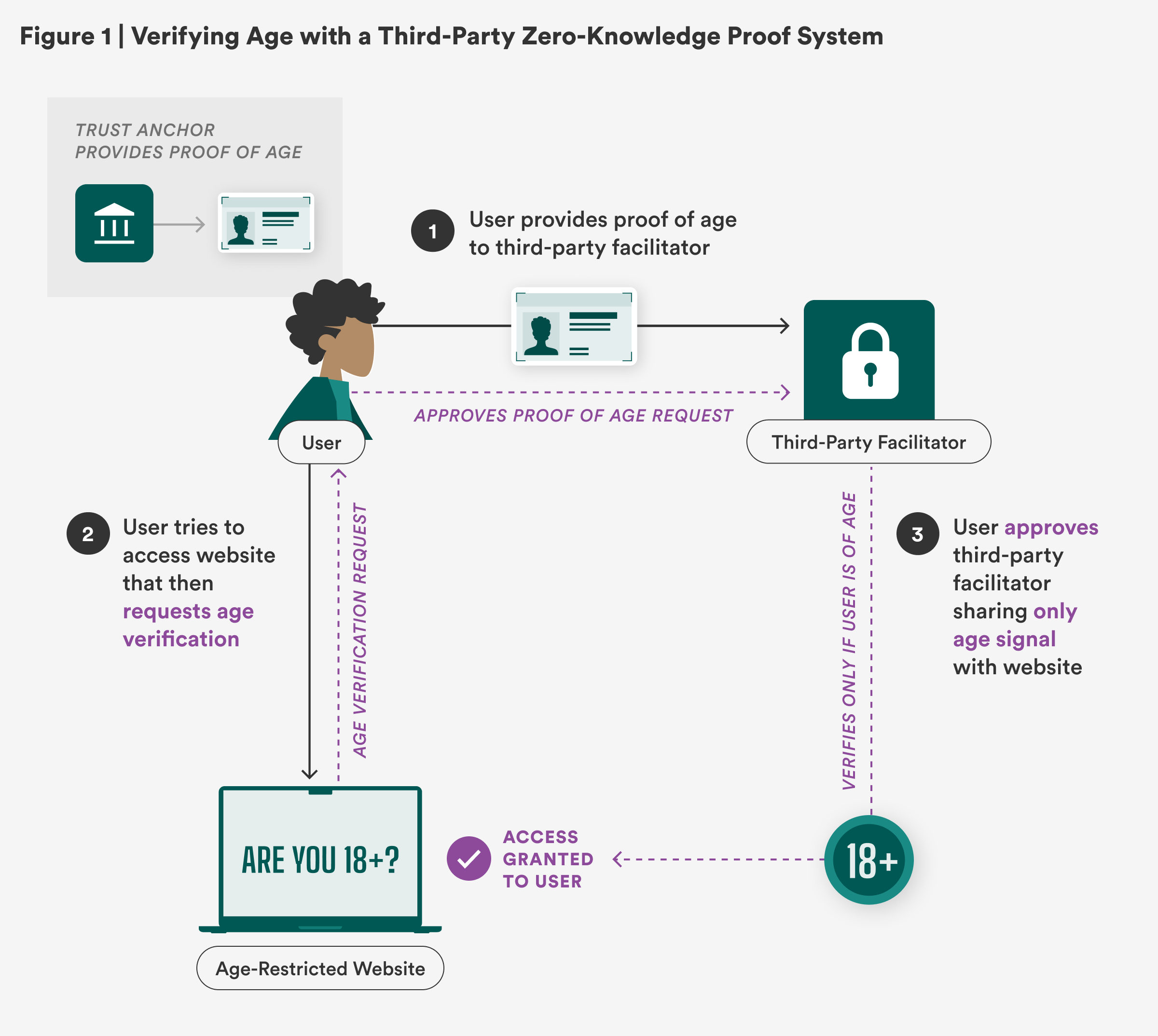
With the circuit defined, the system generates a zero-knowledge proof (such as a SNARK or STARK). This proof mathematically demonstrates that the model executed the circuit correctly for a given input. The proof is compact, allowing it to be verified quickly without re-running the entire, often resource-intensive, inference process. This step is where the "zero-knowledge" aspect shines, as no private data is exposed.
Finally, the proof is submitted to a verifier. This can happen off-chain for speed or on-chain for maximum transparency. On-chain verification ensures that anyone can audit the model’s behavior using the blockchain as a source of truth. The verifier checks the proof against the public parameters, confirming the output is authentic and the model hasn’t been altered.
This workflow shifts trust from the model provider to cryptographic verification. While the computational overhead is currently higher than standard inference, advancements in circuit optimization are steadily reducing these costs, making ZKML a viable path for trustworthy AI deployment.
Real-world ZKML adoption trends
Zero-knowledge machine learning is moving from theoretical papers to concrete deployments. The technology is currently solving a specific bottleneck: verifying AI outputs without exposing the underlying data or model weights. This is critical in sectors where privacy regulations and intellectual property concerns have previously stalled AI integration.
Private healthcare diagnostics
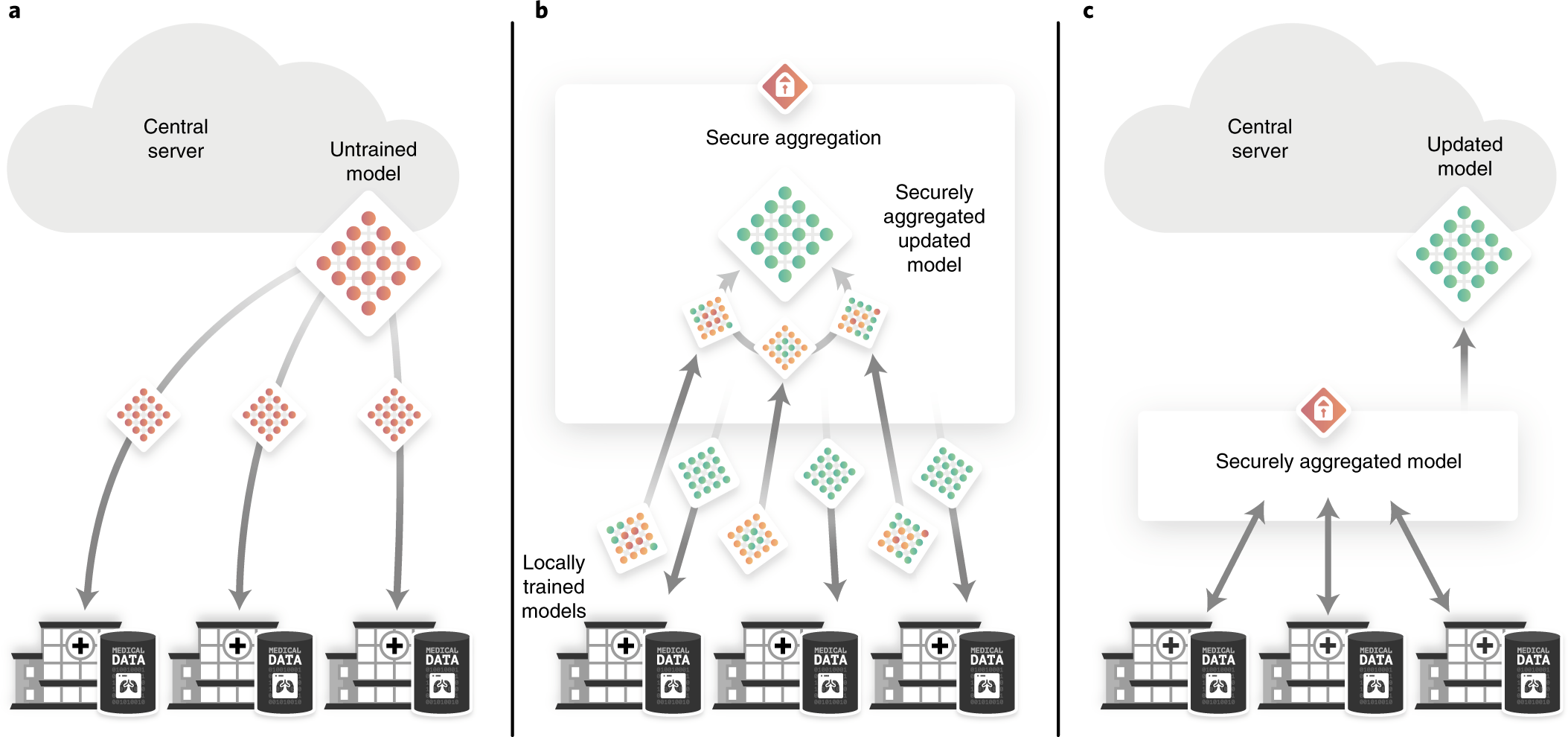
In healthcare, patient data is highly sensitive and heavily regulated. ZKML allows hospitals to verify that an AI model processed patient records correctly without ever revealing the raw data to the third-party verifier. This enables collaborative research and model auditing while maintaining strict compliance with privacy standards like HIPAA. The workflow ensures that the diagnostic result is mathematically proven to be correct, even if the model itself is proprietary.
Secure financial models
Financial institutions face similar challenges. Banks can use ZKML to prove that their credit risk models are fair and compliant with regulatory guidelines without disclosing their proprietary algorithms or customer financial histories. This creates a verifiable audit trail for regulators. It also allows for secure collaboration between competing banks, where they can jointly train models or verify risk assessments without sharing sensitive client data.
Verifiable AI agents
The rise of autonomous AI agents introduces new trust issues. ZKML enables these agents to generate proofs of their actions, ensuring they operated within predefined constraints. For example, a trading bot could prove it executed trades based on specific market conditions without revealing its strategy. This transparency is essential for integrating AI into high-stakes environments where accountability is non-negotiable.
Key projects and frameworks
Several initiatives are driving this adoption forward. Projects like EZKL provide efficient zero-knowledge proof generation for machine learning models. Polygon Miden is integrating ZKML capabilities into its blockchain infrastructure, making it easier for developers to build verifiable applications. Worldcoin is also exploring ZKML to enhance privacy in identity verification systems. These frameworks are lowering the barrier to entry, allowing more organizations to experiment with verifiable AI.
Leading ZKML Projects
-
EZKL
Provides efficient zero-knowledge proof generation for ML models, focusing on performance and ease of integration. -
Polygon Miden
Integrates ZKML into blockchain infrastructure, enabling developers to build verifiable decentralized applications. -
Worldcoin
Explores ZKML for privacy-preserving identity verification, ensuring user data remains confidential while proofs are validated.
Scaling zero-knowledge machine learning
Verifying AI without leaking data sounds ideal, but the computational cost is currently prohibitive for large-scale deployment. Generating zero-knowledge proofs for complex neural networks requires translating mathematical operations into arithmetic circuits, a process that is exponentially more expensive than standard inference.
The primary bottleneck is proof generation time. While verification is fast, creating the proof for a model like a distilled GPT-2 or a state-of-the-art vision model can take hours on high-end hardware. This latency makes real-time applications, such as live fraud detection or interactive AI assistants, impractical with current ZKML frameworks.
Compiling large language models (LLMs) into ZK circuits adds another layer of complexity. LLMs rely on sparse attention mechanisms and large embeddings that do not map efficiently to the dense arithmetic constraints required by ZK-SNARKs. Researchers are developing optimizing systems like ZKML to streamline this process, but the overhead remains significant.
Until hardware acceleration and better circuit compilers mature, ZKML will likely remain confined to batch-processing scenarios where latency is less critical than privacy guarantees.
No comments yet. Be the first to share your thoughts!