
The AI trust gap
Generative AI models operate as opaque black boxes. They take inputs and spit out outputs, but the internal logic remains hidden. This opacity creates a significant trust deficit, particularly in high-stakes industries like healthcare and finance where auditability is not optional. You cannot simply trust a model to be correct or compliant; you need proof.
In healthcare, for example, regulatory frameworks like HIPAA demand strict privacy controls. Traditional AI verification often requires handing over sensitive patient data to a third-party auditor or trusting the model provider’s internal security protocols. This is a fragile approach. If the provider’s systems are compromised or if the model exhibits bias, the damage is done before anyone notices. The current model of "trust but verify" fails because verification itself leaks the very data it aims to protect.
Financial institutions face similar challenges. When banks use AI for credit scoring or fraud detection, they must explain decisions to regulators. If the model is proprietary, the bank cannot prove the decision was made fairly or without discriminatory bias. This lack of transparency stalls adoption. Companies hesitate to deploy AI in critical workflows because they cannot mathematically guarantee the integrity of the output.
The problem is structural. As AI models grow larger and more complex, manual auditing becomes impossible. We need a way to verify that a model performed a specific computation correctly without exposing its weights, its training data, or its proprietary algorithms. This is the core challenge ZKML addresses.
How ZKML proves model integrity
The core problem with modern AI is the "black box." When a bank denies a loan or a hospital flags a risk, stakeholders demand to know why. Yet, proprietary models rarely share their weights, and sensitive data often cannot leave secure servers. This creates a trust gap: you can use the AI, but you cannot verify it. Zero-Knowledge Machine Learning (ZKML) solves this by decoupling the computation from the verification. It allows a system to prove that an AI model executed correctly on specific data without revealing the model itself or the underlying information.
The mechanism works by translating the AI model into a mathematical circuit. This circuit represents every operation the model performs—matrix multiplications, activations, and logic gates—as a set of algebraic constraints. When the model runs on input data, it generates a cryptographic proof. This proof acts as a digital receipt, certifying that the output was produced by the exact same logic defined in the circuit. The verifier checks this receipt against public parameters. If the math holds, the result is accepted as valid, even if the verifier knows nothing about the input data or the secret weights.
This approach is critical in regulated industries. In healthcare, for example, a clinic can use ZKML to prove that a diagnostic model was trained on compliant, anonymized datasets without exposing patient records. In finance, a lender can verify that a credit scoring model follows fair lending laws and uses the correct algorithmic logic, without disclosing their proprietary risk formulas. The proof guarantees integrity and privacy simultaneously.
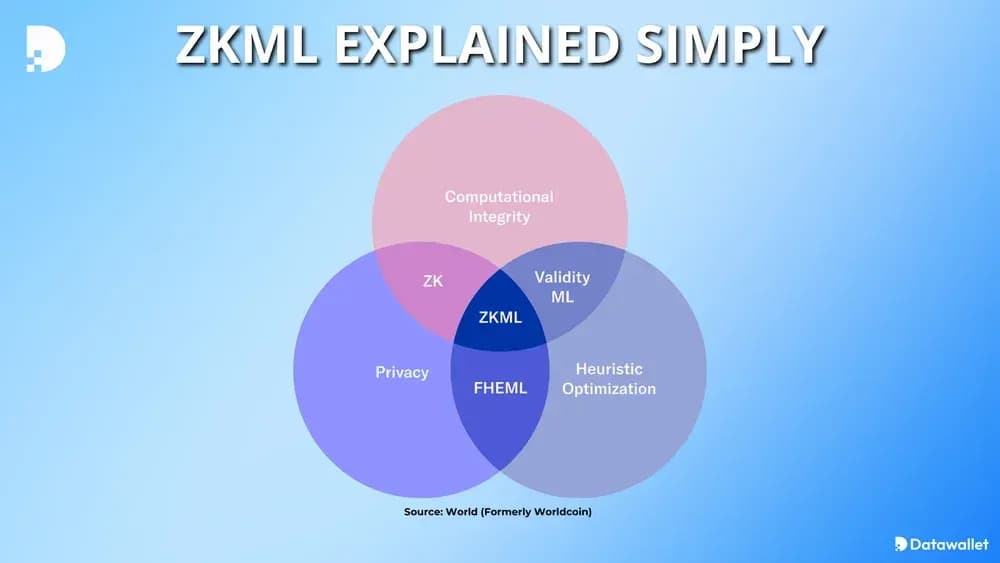
The AI model, often a neural network, is converted into a constraint system. Each layer and activation function is mapped to arithmetic constraints that a zero-knowledge circuit can process. This step translates complex machine learning operations into a format suitable for cryptographic verification.

The prover runs the model on the input data within the circuit. Instead of sharing the data or weights, the prover generates a succinct cryptographic proof. This proof demonstrates that the computation was executed correctly according to the compiled circuit constraints, without revealing the intermediate values.
The verifier receives the proof and the final output. Using public verification keys, the verifier checks the proof's validity. This process is computationally efficient, allowing the verifier to confirm the AI's integrity and the correctness of the result in seconds, regardless of the model's complexity.
Fixing common ZKML integration errors
When ZKML implementations fail, the symptoms usually look like trust issues rather than technical crashes. A healthcare provider might reject a diagnostic AI because the proof generation takes too long, or a financial firm might abandon a model that leaks parameter weights during verification. These failures stem from three specific integration errors: ignoring circuit complexity, underestimating proof latency, and forcing incompatible model architectures.
Circuit complexity bloat
The most frequent error is treating standard neural networks as if they fit directly into a zero-knowledge circuit. Standard models rely on continuous operations like ReLU activations or matrix multiplications that are computationally expensive to prove. When developers do not convert these operations into arithmetic constraints early in the design phase, the circuit size explodes, making proof generation impossible on consumer devices.
To fix this, you must quantize your model. Converting 32-bit floating-point weights to 8-bit integers or even binary values drastically reduces the number of gates required in the circuit. This compression allows the model to run within the memory limits of a zkVM without sacrificing the accuracy needed for basic inference tasks.
Proof generation latency
Another common pitfall is assuming proof generation will be instantaneous. In high-frequency trading or real-time biometric verification, waiting minutes for a proof is a functional failure. The latency comes from the prover having to execute the entire model computation twice: once in the VM and once to generate the proof.
The solution is to use incremental verifiers or recursive proofs. Instead of generating a new proof for every single inference, you can batch operations or use a verifier that checks the validity of the computation against a previous state. This reduces the computational overhead from O(n) to O(1) for repeated checks, making the system viable for live applications.
Model architecture incompatibility
Finally, many teams try to prove models that are fundamentally incompatible with zero-knowledge environments, such as those relying heavily on attention mechanisms or large lookup tables. These structures create sparse constraints that are difficult to encode efficiently.
Start with simpler architectures like logistic regression or small decision trees for initial proofs. As your infrastructure matures, you can move to more complex models like ResNet or lightweight transformers. Always test the proof verification speed on the target hardware before committing to a full-scale deployment.
-
Verify circuit constraints fit within target zkVM memory limits
-
Test proof generation speed on target hardware before full deployment
-
Ensure data privacy compliance by checking for parameter leakage
Comparison of verification methods
| Feature | ZKML | Standard AI Audit | Cloud Verification |
|---|---|---|---|
| Data Privacy | High (Encrypted) | Low (Raw Data) | Medium (Partial) |
| Model Transparency | Proven | Audited | Proprietary |
| Latency | Higher (Proof Gen) | Low | Medium |
| Trust Level | Cryptographic | Statistical | Vendor-Based |
The ZKML ecosystem
Trust is the bottleneck for AI adoption. Enterprises hesitate to deploy generative models because they cannot prove the model isn't leaking training data or producing biased outputs. ZKML addresses this by providing cryptographic proof that a model ran correctly without exposing the underlying data or proprietary weights.
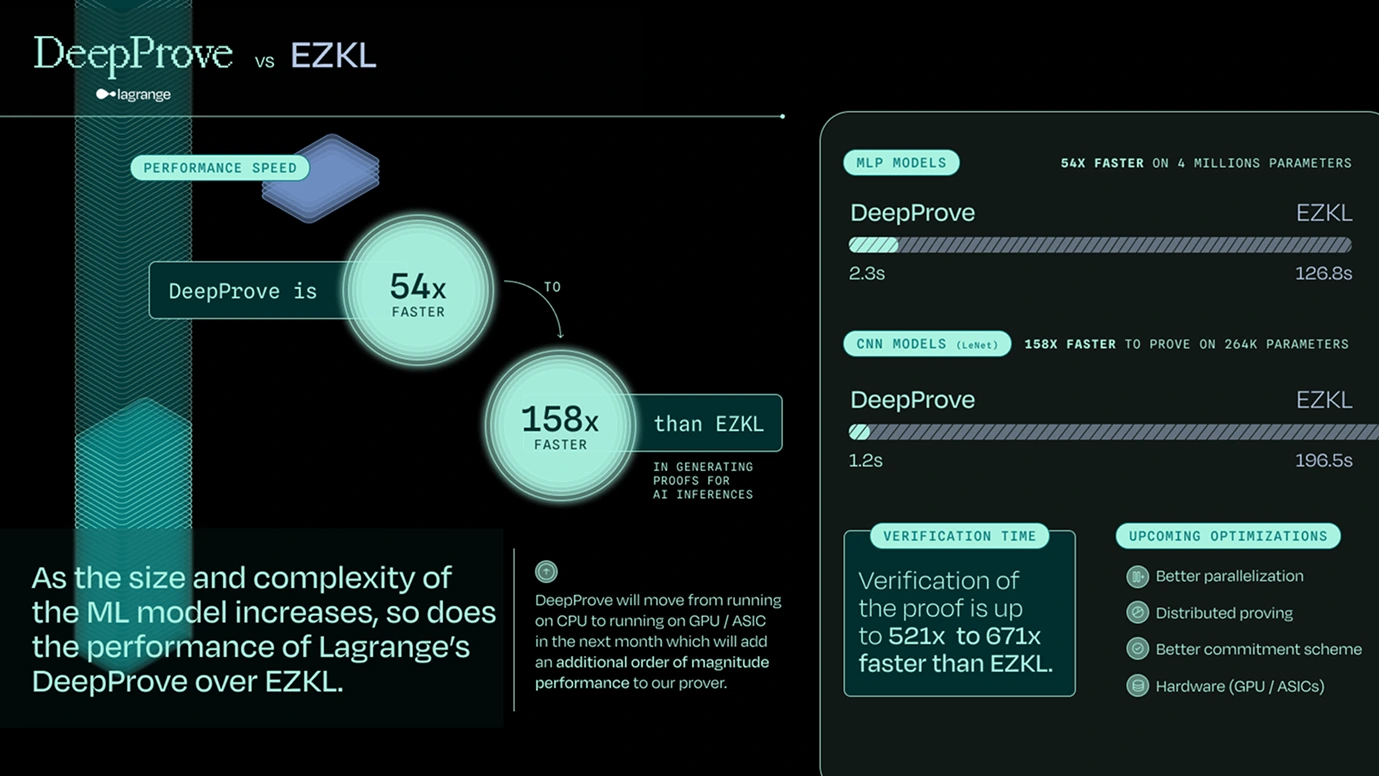
The market is currently fragmented and early-stage. There is no dominant standard yet, but a few projects are defining the infrastructure layer. Polyhedra Network focuses on general-purpose verification, allowing developers to plug ZK proofs into existing AI workflows. EZKL (Easy ZK) takes a different approach by compiling machine learning models directly into efficient zero-knowledge circuits, making it easier for data scientists to verify inference without deep cryptographic expertise.
Most current applications are confined to high-stakes sectors like healthcare and finance. In healthcare, for instance, ZKML allows hospitals to verify a diagnostic model's accuracy without sharing sensitive patient records. In finance, it enables banks to prove a credit scoring model complies with regulations without revealing the algorithm's proprietary logic.
Investment in this space is growing, reflected in the emergence of dedicated tokens and frameworks. The live price of the ZKML token hovers around $0.009, indicating a small but active trading community focused on long-term infrastructure rather than short-term speculation. As the technology matures, expect these tools to move from niche pilots to standard enterprise requirements.
Frequently asked questions about ZKML
These answers address common points of confusion around Zero-Knowledge Machine Learning (ZKML), focusing on how it verifies AI without exposing sensitive data.
No comments yet. Be the first to share your thoughts!