
Narrow down the problem
Before adopting zero-knowledge machine learning (ZKML), identify which specific failure point is blocking your enterprise AI. The "black box" problem is often a catch-all term for three distinct issues: regulatory compliance, model integrity, or data privacy.
If your primary concern is regulatory compliance, you likely face audits where you must prove your model followed specific logic without exposing the underlying proprietary weights. This is where zero-knowledge proofs (ZKPs) become essential, allowing you to certify that a result was produced by the claimed computation without revealing sensitive data or model parameters.
If your issue is model integrity, you need to verify that the inference matches the trained model exactly, ensuring no tampering occurred during deployment. For data privacy, particularly in healthcare or finance, ZKML enables predictive modeling for diagnoses or risk assessment without exposing individual records or raw datasets.
Start by mapping your current bottleneck. Is it legal liability, trust in the output, or data security? Once you isolate the symptom, you can determine if ZKML is the right fix or if a simpler transparency measure suffices.
Verify ZKML AI Model Integrity
ZKML (Zero-Knowledge Machine Learning) lets you prove an AI model ran correctly without exposing the underlying data or weights. For enterprise teams, this solves the "black box" problem by providing cryptographic proof of inference. Instead of trusting the vendor, you verify the output.
Follow this diagnostic sequence to validate your ZKML integration.
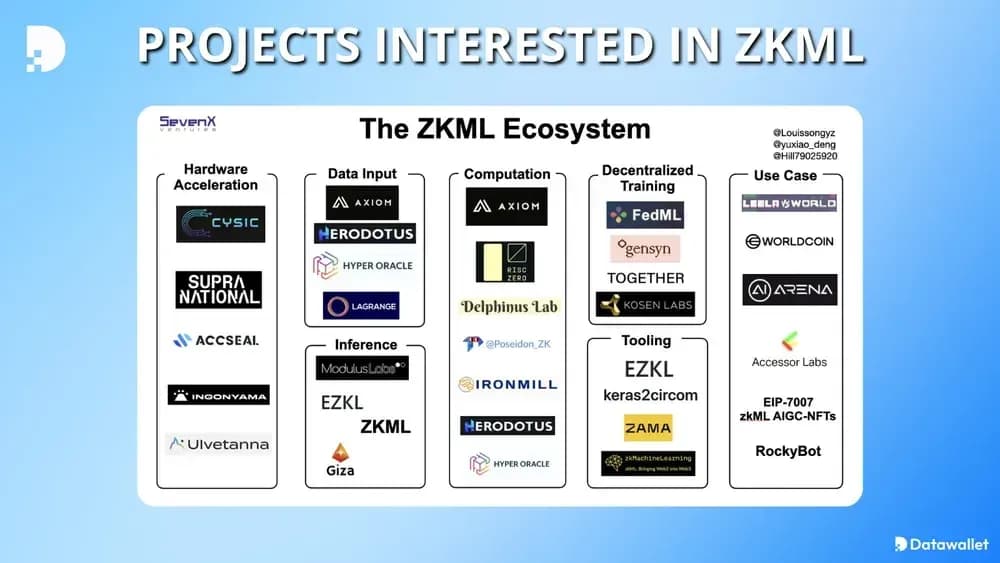
Ensure your pipeline generates a Zero-Knowledge Proof (ZKP) alongside the model output. The proof must certify that the inference was produced by the claimed computation. If no proof exists, the model is just a standard opaque API call.

Run the verification algorithm against the proof. This step checks if the cryptographic signature matches the model’s public parameters. A failed verification means the output is either corrupted or generated by a different model entirely.
ZKML adds significant computational weight. Measure the time delta between a standard inference and a ZKML-verified one. If the latency exceeds your service-level agreements (SLAs), you may need to optimize the proof system or switch to a lighter-weight variant.
Verify that sensitive inputs (like patient records or financial data) never leave the trusted execution environment. The proof should confirm the computation happened on private data without revealing the data itself. This is critical for healthcare and finance use cases.
Common ZKML Pitfalls
- Over-verifying: Proving every single inference can be prohibitively expensive. Use sampling for high-volume, low-risk tasks.
- Ignoring model updates: If you retrain the model, you must update the verification parameters. Old proofs will fail.
- Trust assumptions: Ensure the cryptographic setup (trusted setup ceremony) was performed securely. A compromised setup invalidates all proofs.
-
Generate ZKP with inference output
-
Run verification algorithm
-
Measure latency impact
-
Confirm data isolation
What usually fixes the black box problem
Enterprise AI systems face two distinct types of opacity: the model’s internal logic is unreadable, or you cannot prove the model ran as intended. Zero-Knowledge Machine Learning (ZKML) addresses both by attaching cryptographic proofs to every inference. When you need to fix a black box, the solution depends on whether the issue is trust in the output or trust in the process.
Verify the inference with ZKPs
The most direct fix for the "black box" label is proving that a specific output came from a specific model without revealing the model itself. This uses Zero-Knowledge Proofs (ZKPs) to certify that the training, testing, or inference result was produced by the claimed computation. It allows one party to certify the result without revealing sensitive data or proprietary parameters. This is essential for high-stakes environments like healthcare, where predictive models must diagnose diseases without exposing individual patient records.
Audit the pipeline with verifiable logs
If the issue is not just the final answer but the journey to get there, you need verifiable logs. ZKML systems generate cryptographic receipts for each step of the ML pipeline. These receipts prove that no unauthorized changes were made to the data or the model weights during deployment. This approach shifts the focus from trusting the vendor to verifying the chain of custody, which is critical for compliance in regulated industries.
Balance privacy with performance
The tradeoff for this transparency is computational cost. Generating ZK proofs for large models can be slow and expensive. The fix is to choose the right proof system for your use case. For real-time applications, lighter-weight proofs may suffice, while for batch processing or regulatory audits, heavier proofs provide stronger guarantees. The goal is to find the minimum amount of verification needed to satisfy your stakeholders.
Check for interoperability
Finally, ensure your ZKML solution integrates with your existing infrastructure. The best fix is one that doesn't require a complete overhaul. Look for frameworks that support standard ML models and offer easy-to-use SDKs for proof generation. This ensures that the verification process becomes a standard part of your workflow rather than a separate, cumbersome step.
Zkml ai: what to check next
Before integrating zero-knowledge machine learning into your enterprise stack, it helps to separate the cryptographic mechanics from the broader AI landscape. These answers address the most common practical objections and definitions.
No comments yet. Be the first to share your thoughts!