

Selective zkML Proofs: Verifying High-Risk AI Model Slices for Privacy-Preserving Inference

In the high-stakes world of financial modeling and healthcare diagnostics, AI inferences carry immense responsibility. A single erroneous output from a black-box model could trigger misguided investment decisions or misdiagnoses, yet full transparency risks exposing proprietary algorithms and sensitive patient data. Selective zkML proofs offer a measured solution: verify only the high-risk AI model slices that matter most, ensuring privacy-preserving ML inference without the inefficiency of proving every matrix multiplication.

Traditional zkML vs. Selective zkML Proofs: Efficiency, Privacy & Scalability (ZK-VIN Example)
| Aspect | Traditional zkML (Full Model Proofs) | Selective zkML (High-Risk Slices) | Benefits & Examples |
|---|---|---|---|
| Proof Scope | Entire model inference | High-risk components only | Targeted verification (DSperse); ZK-VIN for scalable AI |
| Proof Generation Time | High (hours for large models) | 46% reduction (TeleSparse) | Faster proofs for production use (Inference Labs ZK-VIN) |
| Prover Memory Usage | High | 67% reduction (TeleSparse) | Enables edge devices & large DNNs |
| Privacy Preservation | Hides full model/weights/data | Hides slices + hybrid non-ZK (opp/ai) | Privacy for sensitive sectors like healthcare/finance |
| Scalability | Limited to small models | Supports large-scale models | Practical zkML (Artemis: 11.5x to 1.2x overhead; ZK-VIN revolutionizes verification) |
| Key Frameworks | ZKML, full SNARKs | DSperse, TeleSparse, opp/ai, ZK-APEX | ZK-VIN: Verifiable inference network with Proofs of Inference marketplace |
This targeted approach aligns with conservative principles in risk management. Traditional zkML demands proving entire models, a computationally prohibitive task for large language models or deep neural networks used in portfolio optimization. Prover times stretch into days, costs balloon, and scalability falters. Selective proofs, however, dissect the model into slices – focusing zk-SNARKs on volatile layers or decision-critical subcomputations – slashing overhead while upholding verifiability.
Overcoming Full zkML Verification Challenges
Full-model zkML, while theoretically sound, stumbles in practice. Frameworks like those from Kudelski Security compress verification for on-chain deployment, but the proof generation scales poorly with model size. For a VGG-style network in fraud detection, commitment checks alone can inflate costs by over 10x. In finance, where models analyze bond yields amid market volatility, such burdens deter adoption. Selective verification sidesteps this by prioritizing high-risk AI verification: prove the output logits or attention heads prone to adversarial attacks, leaving routine convolutions unchecked.
DSperse exemplifies this pragmatism. Its framework targets high-value subcomputations during inference, generating independent proofs for slices using zk-SNARKs. This not only cuts prover memory but enables real-time auditing in decentralized networks – crucial for value investors relying on zkML for tamper-proof fundamental analysis.
Inference Labs and the Selective Proof Paradigm
Inference Labs pioneers scalable verifiable AI through selective zk proofs. Their Proof of Inference framework cryptographically attests to model evaluations, agent decisions, and workflows without revealing weights or inputs. This resonates in conservative portfolios: imagine verifying a high-risk credit scoring slice on-chain, confirming the model processed loan data correctly amid economic uncertainty, all while shielding borrower privacy.
Their ZK-VIN network extends this to decentralized verification, harnessing platforms like Subnet 2 for tamper-proof benchmarking. No longer must we tolerate the dark side of opaque AI; selective proofs deliver trust at scale, reducing costs dramatically compared to holistic zkML.
Recent Breakthroughs in Efficient zk Proofs for AI
2026 brings momentum. Artemis introduces Commit-and-Prove SNARKs tailored for zkML, slashing prover costs with black-box compatibility. For VGG models, commitment overhead drops from 11.5x to 1.2x – a boon for zkML model slicing in resource-constrained environments. opp/ai hybridizes optimistic ML with zkML, partitioning models into sensitive (zk-proven) and non-sensitive (optimistic) submodels, ideal for on-chain financial oracles balancing speed and security.
TeleSparse pushes practicality further: sparsification and neural teleportation yield 67% less prover memory and 46% faster proofs, with mere 1% accuracy dip. In high-risk scenarios like personalized unlearning via ZK-APEX, Halo2 proofs verify transformations on edge devices in hours, proof sizes at 400MB. These tools democratize efficient zk proofs ai, enabling conservative deployment in bonds analysis where data silos demand ironclad privacy.
Proofs of Inference rounds out this ecosystem as a marketplace for zk-SNARK-based inferences. Users request private computations, providers generate proofs stored on decentralized storage, fostering auditable AI without centralized trust. For value investors, this means verifying high-risk AI verification in alpha generation models – confirming that a neural net’s risk-adjusted return forecast used accurate earnings data, sans exposure.
Practical Applications: Finance and Healthcare Use Cases
In finance, selective zkML proofs transform portfolio management. Consider a deep learning model slicing bond durations amid yield curve shifts. Traditional verification proves the full forward pass, but selective proofs target the zkML model slicing around interest rate sensitivity layers. This verifies outputs against ground truth without leaking proprietary yield curves, aligning with conservative mandates for data silos in mutual funds. DSperse’s targeted subcomputations shine here, enabling real-time audits during market stress tests.
Healthcare parallels this rigor. Diagnostic models for rare diseases risk false negatives in edge cases. TeleSparse’s sparsification verifies only high-risk classifier heads, cutting proof times by nearly half while preserving 99% accuracy. Providers attest to inference integrity on encrypted patient scans, regulators confirm compliance, patients retain privacy – a trifecta long sought in HIPAA-bound environments.
Zcash Technical Analysis Chart
Analysis by Market Analyst | Symbol: BINANCE:ZECUSDT | Interval: 1D | Drawings: 8
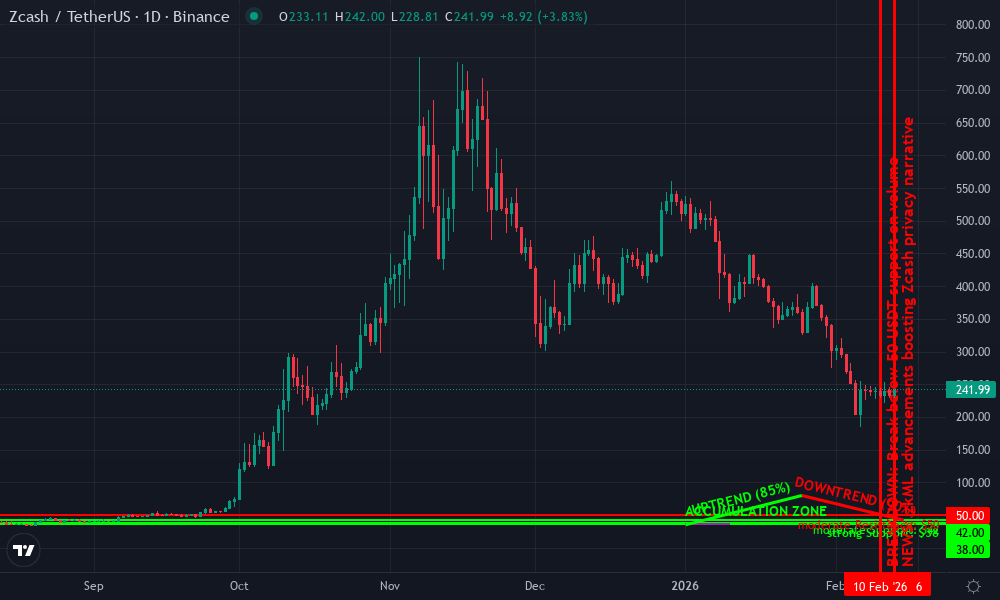
Technical Analysis Summary
To illustrate this ZECUSDT chart analysis in my balanced technical style, start by drawing a prominent downtrend line connecting the recent swing high around 75 USDT on 2026-01-20 to the current lows near 42 USDT on 2026-02-15, using ‘trend_line’ with red color for bearish bias. Add horizontal lines at key support 38 USDT (strong, green thick) and resistance 50 USDT (moderate, red dashed). Mark the consolidation rectangle from 2026-02-01 (40 USDT) to 2026-02-15 (48 USDT). Place arrow_mark_down at MACD bearish crossover around 2026-02-10. Use vertical_line for zkML news event on 2026-02-13. Add fib_retracement from pump low 35 USDT (2026-01-01) to high 80 USDT (2026-01-25). Entry long at 40 USDT with order_line green, stop_loss at 38, profit_target 55. Callout volume spike on pump with ‘callout’. Text notes for insights.
Risk Assessment: medium
Analysis: Volatile post-rally correction with news catalyst; support holds but breakdown risk if zkML hype fades
Market Analyst’s Recommendation: Wait for confirmation above 45 or dip-buy 38-40 with tight stops, medium position size
Key Support & Resistance Levels
📈 Support Levels:
-
$38 – Strong demand zone tested multiple times post-dump
strong -
$42 – Recent minor support holding current price
moderate
📉 Resistance Levels:
-
$50 – Initial retracement resistance from 50% fib
moderate -
$60 – Prior swing high, psychological barrier
weak
Trading Zones (medium risk tolerance)
🎯 Entry Zones:
-
$40 – Bounce from strong support 38-40 zone, zkML tailwind potential
medium risk -
$45 – Break above short-term resistance for continuation play
low risk
🚪 Exit Zones:
-
$55 – Profit target at minor resistance and 38.2% fib retrace
💰 profit target -
$38 – Invalidation below key support
🛡️ stop loss -
$52 – Trailing stop at recent highs
💰 profit target
Technical Indicators Analysis
📊 Volume Analysis:
Pattern: decreasing on correction, spike on dump
High volume on initial pump confirmed strength, fading volume suggests exhaustion
📈 MACD Analysis:
Signal: bearish crossover
MACD line crossed below signal mid-Feb, histogram negative
Applied TradingView Drawing Utilities
This chart analysis utilizes the following professional drawing tools:
Disclaimer: This technical analysis by Market Analyst is for educational purposes only and should not be considered as financial advice.
Trading involves risk, and you should always do your own research before making investment decisions.
Past performance does not guarantee future results. The analysis reflects the author’s personal methodology and risk tolerance (medium).
opp/ai adds nuance for hybrid deployments. By partitioning models – zkML for credit risk logits, optimistic for feature engineering – it balances verifier speed with privacy. In a decentralized lending protocol, this verifies loan approvals on-chain, crucial when economic downturns amplify default predictions.
Conservative Strategies for zkML Integration
As a portfolio manager, I approach zkML with measured optimism. Full proofs suit toy models; selective variants scale to production. Start small: integrate Inference Labs’ Proof of Inference for agent-based trading signals. Verify decision slices post-backtest, ensuring no tampering in volatility regimes. Costs plummet – from days to minutes – without sacrificing verifiability.
Layer in Artemis for commitment efficiency. Its black-box SNARKs retrofit existing pipelines, reducing VGG prover loads dramatically. Pair with ZK-APEX for model hygiene: unlearn stale training data from personalized alpha models, proving erasure without retraining. This fortifies long-term stability, shielding against regulatory scrutiny in privacy-first eras.
Challenges persist, demanding caution. Proof sizes hover at hundreds of megabytes, straining on-chain storage. Verifier latency, though improved, lags native inference. Yet, momentum builds: modular circuits and recursive proofs will compress further. Conservative adopters prioritize pilots in high-conviction areas – fraud detection, ESG scoring – scaling as matures.
Selective zkML proofs mark a pivot from theoretical promise to pragmatic tool. They empower privacy-preserving ML inference where stakes demand it most, without the drag of universal proofing. In finance’s volatile arena, this fosters data-driven confidence: models verified slice by critical slice, privacy intact, decisions grounded. The zkML era arrives not with fanfare, but deliberate, verifiable steps forward.