
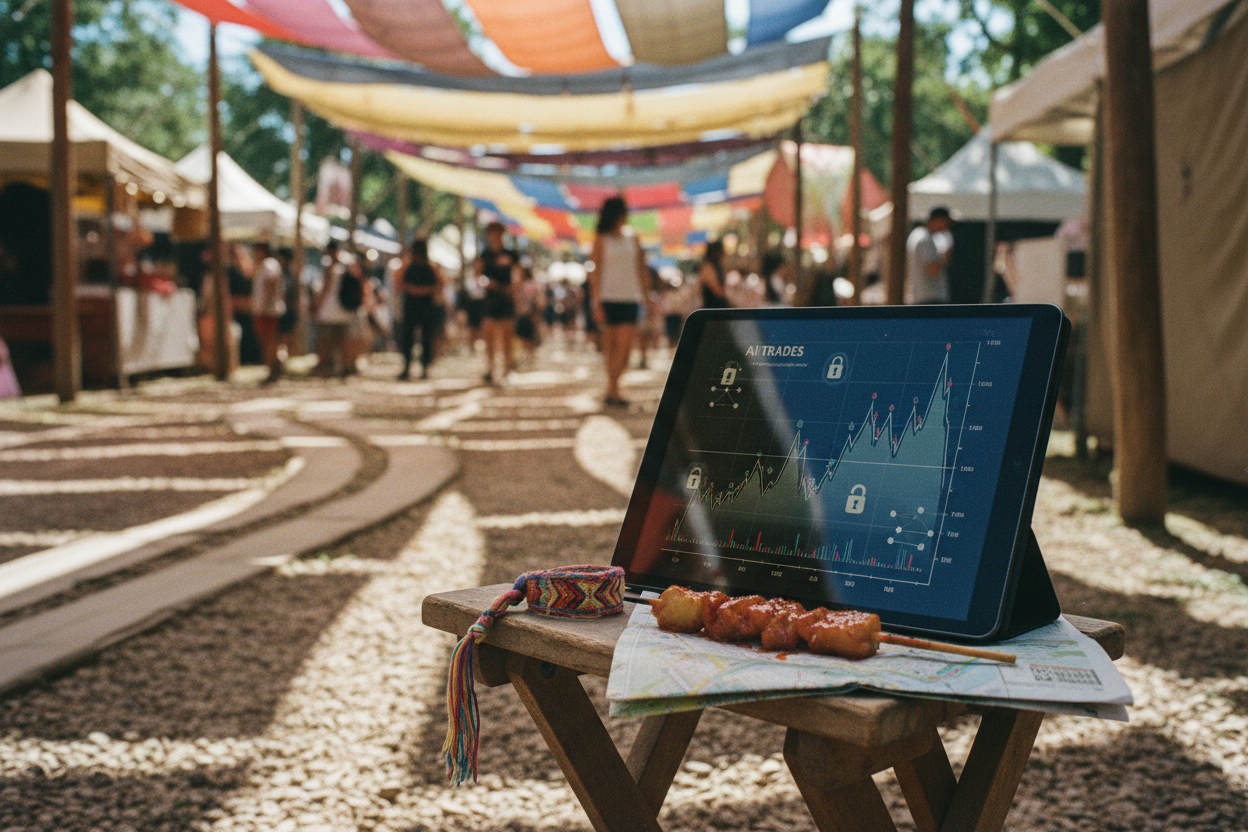
In the volatile arena of cryptocurrency trading, where Bitcoin hovers at $76,383.00 after a 24-hour dip of -2.95% from a high of $78,921.00, AI agents are stepping up to execute multimillion-dollar trades. Picture an autonomous system spotting a fleeting pattern in forex pairs or crypto charts, greenlighting a $2 million position. But how do you prove it acted correctly without exposing proprietary strategies or sensitive market data? Enter the showdown: zkML vs TEE for AI trade verification. As a chartist leveraging zkML for noise-free signals, I've seen firsthand how these technologies redefine verifiable AI finance.
The agentic economy demands ironclad proofs. Agents managing DeFi vaults or executing high-frequency trades can't rely on blind trust. Without robust verification, a single flawed inference could evaporate fortunes amid swings like Bitcoin's recent tumble to a low of $72,971.00. zkML and TEEs emerge as frontrunners, each promising cryptographic integrity but trading off in scalability, privacy, and trust models.
Unpacking zkML: Mathematical Certainty for AI Outputs
Zero-Knowledge Machine Learning flips the script on verifiable AI finance. It generates succinct proofs attesting that an AI model processed data correctly and adhered to specified logic, all without leaking inputs, weights, or internals. Imagine your zkML-enhanced pattern recognition system proving it detected a head-and-shoulders reversal in BTC/USD without revealing the exact chart data or model hyperparameters. This is gold for privacy-sensitive trades, where competitors lurk.
Proponents highlight its trustlessness: no hardware reliance, pure math. An agent buys data, runs inference, delivers results, and attaches a ZK proof for every step, enabling atomic on-chain settlement. Yet, the computational heft remains a hurdle for massive models; proving large neural nets drains resources. Still, innovations from labs like 0G Labs zkML are slashing costs, positioning it as the scalable path for on-chain agents.
In my practice, zkML amplifies technical analysis by filtering market noise through provable computations, ideal for aggressive-medium strategies in crypto volatility.
TEEs: Hardware Fortresses Guarding AI Inference
Trusted Execution Environments offer a contrasting fortress: hardware enclaves like Intel SGX or ARM TrustZone that encrypt data and code during execution. Run your AI trade model inside a TEE, and it shields sensitive inputs from the host system, emerging with outputs you can audit for integrity. Benchmarks of TEE-based coprocessors like Oyster show snappier performance against zkML libraries for certain workloads, making it tempting for low-latency $2M trades.
Privacy shines here too; user data stays encrypted end-to-end, a zkML blind spot. But here's the rub: you trust the silicon gods. Manufacturers hold the keys to attestation, and history brims with exploits cracking these enclaves. Side-channel attacks have felled TEEs before, undermining the very integrity they vow. In a world of nation-state adversaries eyeing financial AI, this hardware trust feels brittle.
Hybrid visions tantalize: Proof-of-Action schemes weaving zkML, TEEs, and content provenance for audit-ready agents. Optimistic TEE-rollups pair enclave speed with ZK verification, curbing costs while bolstering proofs for DeFi executions.
Bitcoin (BTC) Price Prediction 2027-2032
Projections in the Context of zkML and TEE Advancements for Verifiable AI-Driven Trades
| Year | Minimum Price (USD) | Average Price (USD) | Maximum Price (USD) |
|---|---|---|---|
| 2027 | $80,000 | $105,000 | $140,000 |
| 2028 | $120,000 | $180,000 | $260,000 |
| 2029 | $160,000 | $250,000 | $380,000 |
| 2030 | $220,000 | $350,000 | $550,000 |
| 2031 | $300,000 | $500,000 | $800,000 |
| 2032 | $420,000 | $700,000 | $1,200,000 |
Price Prediction Summary
Bitcoin's price is projected to grow significantly from its 2026 base of $76,383, with average annual prices rising progressively due to Bitcoin halving cycles (2028, 2032), hybrid zkML-TEE integrations enhancing trust in AI trading and DeFi, and broader institutional adoption. Bullish maxima reflect optimistic AI agent economy expansion, while minima account for potential bear markets or regulatory hurdles.
Key Factors Affecting Bitcoin Price
- Hybrid zkML and TEE solutions enabling secure, verifiable $2M+ AI trades boosting DeFi and BTC utility
- Bitcoin halvings in 2028 and 2032 reducing supply and driving scarcity
- Increasing adoption of verifiable AI agents in crypto markets
- Regulatory clarity and institutional inflows amid maturing crypto ecosystem
- Macroeconomic trends, market cycles, and technological scalability improvements
- Competition from altcoins balanced by BTC's store-of-value dominance
Disclaimer: Cryptocurrency price predictions are speculative and based on current market analysis. Actual prices may vary significantly due to market volatility, regulatory changes, and other factors. Always do your own research before making investment decisions.
Trade-Offs Exposed: When zkML Outshines TEE in High-Value Stakes[/h2>
Dissecting zkML vs TEE through a trader's lens reveals stark choices. zkML demands upfront compute but delivers universal verifiability, crucial for decentralized ecosystems where no single party dominates. TEEs sprint ahead in speed for real-time decisions, yet their vulnerability to physical attacks disqualifies them for adversarial settings like public blockchains.
Consider Bitcoin's current stance at $76,383.00: an AI agent flagging a rebound from $72,971.00 low needs proof resilient to scrutiny. zkML ensures the signal was noise-free and rule-compliant, fostering trustless DeFi. TEEs might falter if enclave compromises surface post-trade. As agents evolve, zkML's logic-focused proofs herald the trustless dawn, per ChainScore Labs insights.



No comments yet. Be the first to share your thoughts!